When most business owners think about SEO, they think about “backlinks”—those digital high-fives from other websites. While those are important, there is a much more powerful tool sitting right under your nose: your own website’s architecture.
Think of your website as a grand library. You can have the most brilliant books (content) in the world, but if the aisles aren’t labeled and the index is missing, nobody—not even Google—will ever find them. This is where internal link siloing comes in. It is the invisible infrastructure that tells search engines which pages are your “power players” and how your information is organized.
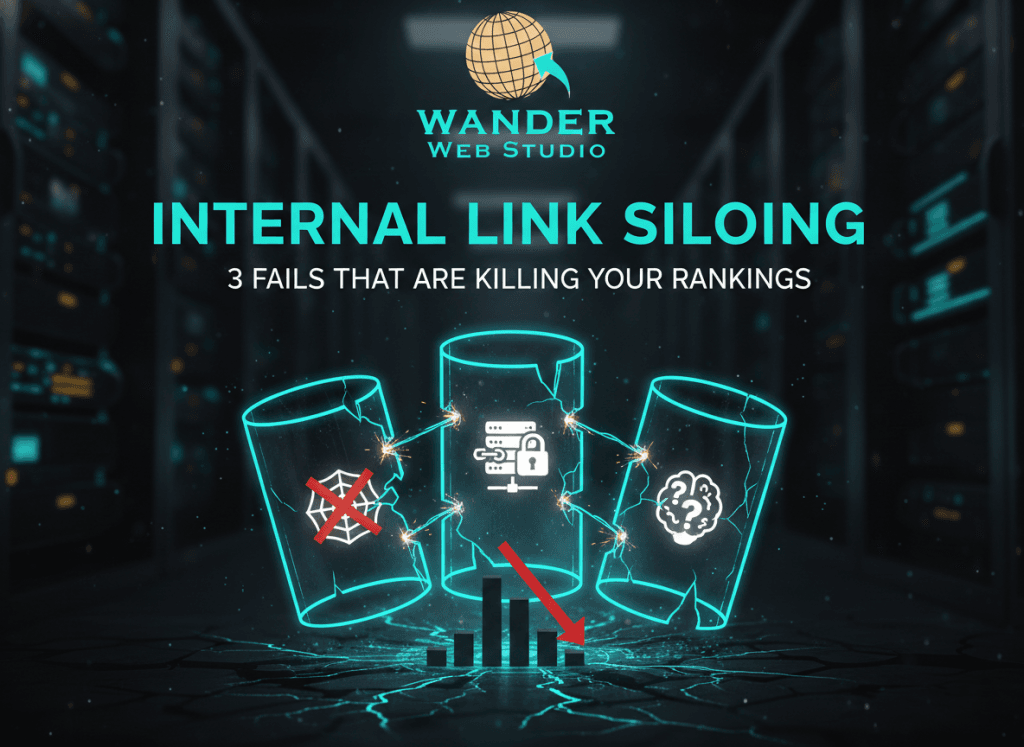
At Wander Web Studio, we see brilliant entrepreneurs build beautiful sites that unfortunately act like mazes rather than maps. If your internal links are a mess, you aren’t just confusing your users; you are actively killing your search rankings. Let’s dive into the three biggest fails we see in the wild and how to fix them.
The most common mistake is what I call “Spaghetti Linking.” This happens when you link every page to every other page without any rhyme or reason. You might think you’re being helpful by giving users “options,” but to Google’s crawlers, this looks like a tangled mess.
When you don’t use internal link siloing, you dilute your “link equity” (the SEO juice that helps pages rank). Instead of a focused stream of authority, you have a leaky bucket. Strategic siloing involves grouping related content into “clusters” that all point back to a main “Hub” or service page.
For example, if you offer Houston web design services, all your blog posts about Houston business trends or local UX preferences should link back to that specific GEO page. This tells Google: “This page is the ultimate authority on this specific topic in this specific location.”
According to Search Engine Journal, internal linking is one of the most underutilized strategies for building topical authority. When you silo correctly, you aren’t just ranking for one keyword; you are proving to search engines that you are an expert in an entire category.
✦ Wanderer’s Wisdom: Think of your website like a tree. Your homepage is the dirt, your main service pages are the trunks, and your blog posts are the branches. Keep the energy flowing within the same branch! If you are writing about San Antonio web design, link to other San Antonio-focused content to keep that “silo” strong.
This is a “silent killer” of SEO rankings. Anchor text is the clickable part of a link, and it serves as a massive signal to Google about what the destination page contains.
If your site is littered with “Click Here,” “Read More,” or “Download Now,” you are wasting a prime opportunity to rank. Google uses anchor text to understand context. If you link to your custom web design page using the words “custom web design,” you are giving that page an SEO boost. If you use “click here,” you’re giving it nothing.
It’s not just about the bots, though. Descriptive anchor text is a huge part of user experience (UX) psychology. It gives your human visitors confidence. They know exactly where they are going before they click. This reduces “friction”—that split-second hesitation that leads to a bounce.
Whether you are serving a global audience or a local niche, clarity always wins over cleverness.
An “Orphan Page” is a page that exists on your site but isn’t linked to by any other page. It’s like a room in your house with no doors.
If a page has zero internal links pointing to it, Google’s crawlers might never find it, and even if they do, they’ll assume the page isn’t important. We often see this with older blog posts or new GEO-targeted landing pages. You spent time and money creating that content—don’t let it sit in a dark corner!
Every time you publish a new piece of content, your first task should be to find 2-3 older, relevant pages and link to the new post. This is the “Safety Net” that keeps your content indexed and alive. This is a core part of any proactive WordPress maintenance plan—ensuring the “circulatory system” of your site is actually moving blood to every limb.
✦ Wanderer’s Wisdom: Don’t let your visitors hit a dead end! Every single page on your site should have a “Next Step.” If someone finishes a blog post, don’t just let them leave. Use internal link siloing to lead them to a related service or your contact page to keep the conversation going.
At the end of the day, your website architecture is about more than just “ranking.” It’s about building a professional, trustworthy environment for your customers. When your site is easy to navigate and logically organized, you aren’t just a business—you’re an authority.
At Cocha Technology, we focus on the technical infrastructure that makes this kind of scaling possible. And here at Wander Web Studio, we turn that infrastructure into a beautiful, user-focused reality.
Through our parent company, Cocha Technology Inc., we are officially multi-certified as: WBE | MBE | SBE | HABE
4321 Kingwood Drive, Suite 222
Kingwood Texas 77339
Phone: 281-607-0616
Email: info@wanderwebstudio.com
Operating on Central Standard Time (CST) | Serving Clients Across All Time Zones
Copyright © Wander Web Studio. All Rights Reserved.
