If your website is currently a collection of random blog posts, you aren’t just confusing your readers—you’re confusing Google. In the high-stakes digital landscape of 2026, search engines have moved beyond simply “reading” pages; they are analyzing your entire site’s Siloing and intent. To dominate search results today, you need a blueprint. Mastering the pillar page is the most effective way to organize your site’s content into a logical, authoritative system that search engines can easily crawl, understand, and reward.
A pillar page is a comprehensive, high-level resource that covers a broad topic in depth, which then links out to more specific “cluster” posts. Think of it as the ultimate guide to a core facet of your business. This creates a powerful web of internal links that signals to search engines exactly what you are an expert in. Without this structure, your best content is just a needle in a digital haystack, destined to be buried under the thousands of pages published every second.
In 2026, the internet is flooded with AI-generated noise. Search engines like Google have responded by prioritizing “Topical Authority.” They want to see that you aren’t just “mentioning” a keyword, but that you truly own the subject matter. A pillar page is your flag in the sand; it is your declaration that you are a definitive resource for your audience.
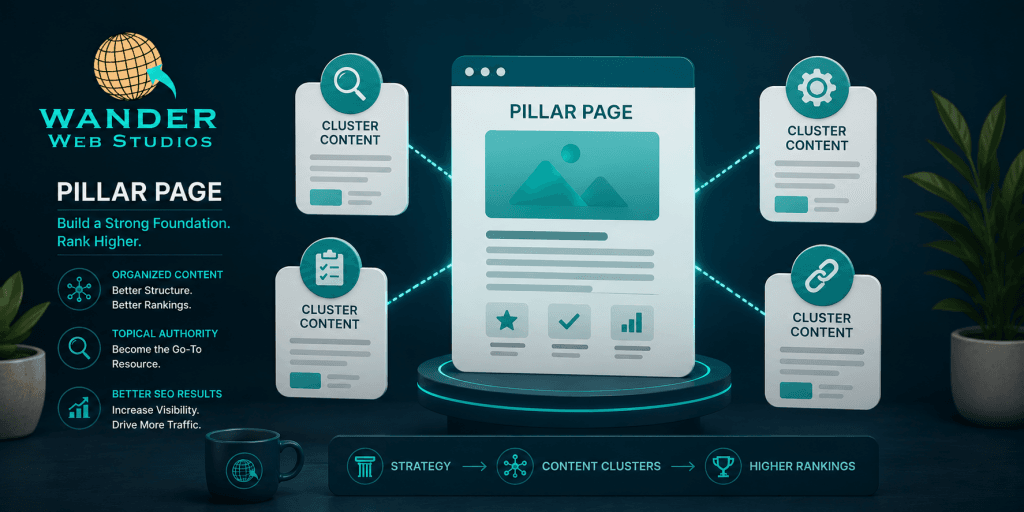
Think of the pillar page as the hub of a wheel. Your sub-topic blogs are the spokes. This model is the physical manifestation of proper Siloing. By grouping related content together, you prevent your own pages from competing with each other in search results—a common disaster known as keyword cannibalization.
In a hub-and-spoke model, your pillar page provides the broad overview (the “What” and “Why”), while your cluster posts handle the “How-To” and the specific technical details. This satisfies both the user who needs a quick summary and the deep-diver who wants to know every nuance.
For example, if your pillar page is about “Web Design for Small Businesses,” your cluster posts (the spokes) might include:
The Psychology of Color in Branding
How to Choose the Right Font for Mobile Readability
Why Your Home Page Needs a Clear Call to Action
The Technical Side of Hosting and Site Speed
By linking all of these “spokes” back to the central “hub,” you create a closed-loop system of authority. When one post starts to rank, it pulls the rest of the cluster up with it.
When you engage in mastering the pillar page, you are optimizing your “Crawl Budget.” Search engine bots have a limited amount of time to spend on your site during each visit. A messy, flat architecture forces bots to dig through irrelevant links. A clear pillar-and-cluster architecture ensures they spend that precious time on your most important content.
According to Digital Applied, websites that successfully implement cluster architectures see 40% higher topical authority ratings. This is because you aren’t just ranking for a single word; you are proving to the algorithm that you own the entire conversation around a subject. This technical cleanliness also makes your site more resilient to algorithm updates, as Google can easily see that your site is organized for the user’s benefit, not just for “gaming” the system.
Users love pillar pages because they act as a “one-stop shop.” In an era of information overload, people value curation. If someone lands on your page looking for web design advice, a pillar page gives them the big picture and then invites them to go deeper into specific topics like Scannability or Evergreen Strategy.
This increases “dwell time” (how long someone stays on your site), which is a massive positive signal to search engines that your site is helpful and relevant. More importantly, it builds trust. When a user finds everything they need in one place, they stop looking at your competitors. You become their trusted advisor, not just another search result.
You cannot master the pillar page without an Evergreen Content Strategy. Evergreen content is high-value, timeless information that remains relevant to your audience indefinitely. Unlike news-heavy posts or seasonal updates that expire before the next quarter, evergreen content is the fuel that keeps your pillar page ranking for years.
When you combine a Pillar Page (the structure) with Evergreen Content (the substance), you create a permanent business asset. You stop the “content treadmill” and start building a library that earns you leads while you sleep.
In 2026, we are seeing the full implementation of AI-driven search results. These systems don’t just look for keywords; they look for “Semantic Relationships.” They want to see how concepts connect. A well-organized pillar page essentially “spoon-feeds” this information to the AI. By using clear headings, structured data, and logical internal linking, you are making it incredibly easy for search engines to categorize your business accurately.
Audit Your Existing Content: Look for a broad topic you’ve already written about several times.
Define Your Core Topic: Ensure it is broad enough to support at least 5–10 sub-topics.
Create the Pillar: Write a long-form piece (2,000+ words) that touches on every sub-topic briefly.
Link the Spokes: Link every existing sub-topic blog to the pillar, and link the pillar to every sub-topic blog.
Apply Siloing: Ensure the pillar page has a direct, clear path to your services.
Wanderer’s Wisdom: When I start a new design project, the first thing I look at isn’t the colors—it’s the architecture. I once saw a site with 200 blog posts that was getting almost no traffic. We reorganized those posts into 5 clear Pillar Pages. Without writing a single new word, their traffic jumped by 50% because Google finally understood what the site was about. You can’t build a mansion on a swamp; you need a foundation.
Most websites suffer from being a “junk drawer” of ideas. You might have great information, but if it’s buried under layers of irrelevant posts, neither Google nor your customers will ever find it.
Mastering the pillar page is the only way to ensure your website serves as a high-performing lead generation tool in 2026. It’s time to stop the content treadmill, clear out the “dead weight,” and start building a digital library that grows in value every single day.
Let’s talk about your site architecture and build a strong foundation.
Turn your website into a high-performance business tool.
Through our parent company, Cocha Technology Inc., we are officially multi-certified as: WBE | MBE | SBE | HABE
4321 Kingwood Drive, Suite 222
Kingwood Texas 77339
Phone: 281-607-0616
Email: info@wanderwebstudio.com
Operating on Central Standard Time (CST) | Serving Clients Across All Time Zones
Copyright © Wander Web Studio. All Rights Reserved.