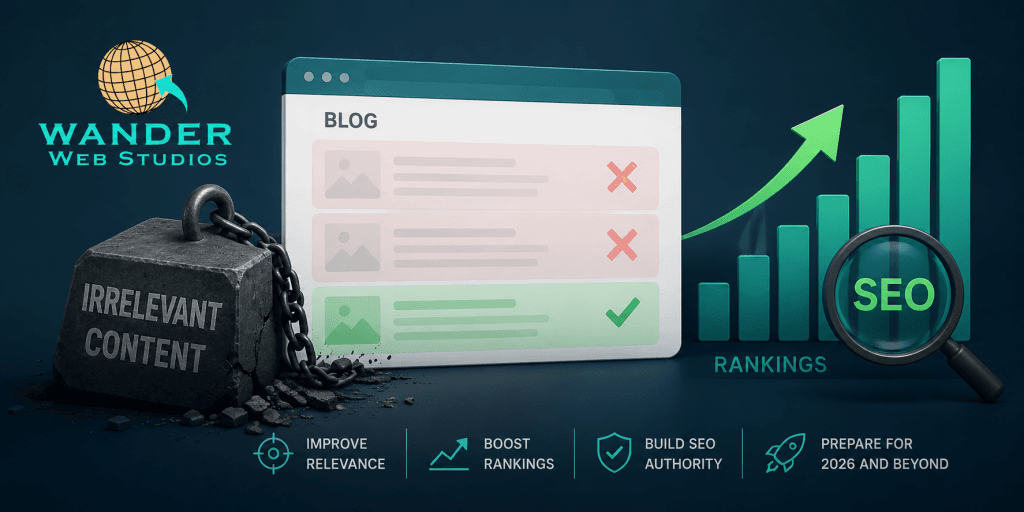
In my experience of navigating the digital landscape, I have seen websites evolve from simple digital brochures into complex, data-heavy machines. However, with that growth comes a hidden danger that most business owners completely overlook: the “Digital Junk Drawer.” We often feel that more content equals more authority, but in 2026, the opposite is frequently true. If you are not careful, you are likely to stop hosting “dead weight” only after it has already tanked your search engine rankings.
Think of your website like a high-performance athlete. To win the race in 2026, that athlete needs to be lean, focused, and efficient. Every irrelevant blog post, every 300-word update from a 2014 networking event, and every duplicate “keyword-stuffed” page acts like a lead weight strapped to that athlete’s ankles. It slows down your crawl speed, confuses search engines, and—worst of all—dilutes the trust your human visitors have in your brand.
The core reason you must stop hosting “dead weight” is a technical one involving how search engines view your site’s overall quality. Google’s algorithms, particularly after the massive updates in 2025 and early 2026, no longer look at pages in total isolation. They look at the “Topical Authority” and “Helpfulness” of your site as a whole.
If 60% of your website consists of low-value or irrelevant blog posts, search engines start to view your entire domain as a low-quality source. This is often referred to as “Content Dilution.” You might have five brilliant, 2,000-word pillars, but they are being drowned out by three hundred “thin” posts that offer no unique value. By performing a rigorous SEO cleanup, you are essentially telling the algorithm: “Focus here; this is the good stuff.”
Search engine bots are not infinite. They have what is known as a “Crawl Budget”—a limited amount of time and resources they allocate to indexing your site. When you refuse to stop hosting “dead weight”, you are forcing these bots to waste their time crawling pages that will never rank, never be read, and never convert.
When a bot spends its budget on a 2017 post about an office potluck or a short-lived industry trend that is no longer relevant, it may never reach your high-value Wander Web Studio services pages. A clean, pruned site ensures that every time a search engine visits, it sees your freshest, most authoritative content first.
It’s not just about the bots; it’s about the people who pay your bills. Imagine a potential client searches for a professional web designer, lands on an old, broken post through a random long-tail query, and sees outdated information or low-quality, non-responsive images from a decade ago.
They don’t think, “Oh, this is just an old post.” They think, “This company isn’t keeping up.” They immediately “bounce” back to the search results. High bounce rates send a negative signal to search engines, further damaging your Mastering the Pillar Page strategy. In 2026, your brand is only as strong as its weakest page.
How do you actually begin to stop hosting “dead weight”? You need a “Garden Method” for your content.
The Audit: Use tools to identify pages with zero traffic and zero backlinks over the last 12 months.
The Red Pen: If the content is outdated but relevant, refresh it. If it’s irrelevant and low-traffic, delete it.
The Redirect: When you delete a page, always use a 301 redirect to send that “link juice” to a relevant, high-performing page.
This is the mechanical core of a successful SEO cleanup. It moves your site from a “junk drawer” to a curated library. According to Search Engine Journal, websites that perform regular content pruning often see an increase in sitewide organic traffic of up to 30% because the “average” quality of the site rises instantly.
The fear of “losing” content is real, but the danger of keeping it is higher. To maintain a healthy, high-ranking presence, you must be a ruthless curator of your own digital space. Stop hosting “dead weight” and start investing in the deep, authoritative Siloing of your core expertise.
At Wander Web Studio, we don’t just build websites; we maintain digital ecosystems. We help you find the “weeds” and ensure your “perennials” have the room they need to grow.
Ready to clear the fog? Let us help you prune your digital garden and let your best work shine.
Turn your website into a high-performance business tool.
Through our parent company, Cocha Technology Inc., we are officially multi-certified as: WBE | MBE | SBE | HABE
4321 Kingwood Drive, Suite 222
Kingwood Texas 77339
Phone: 281-607-0616
Email: info@wanderwebstudio.com
Operating on Central Standard Time (CST) | Serving Clients Across All Time Zones
Copyright © Wander Web Studio. All Rights Reserved.