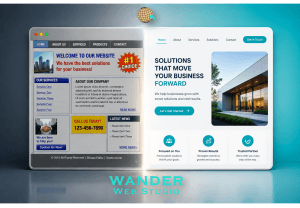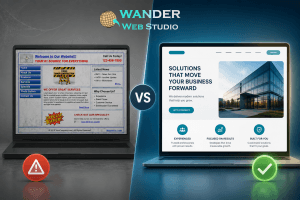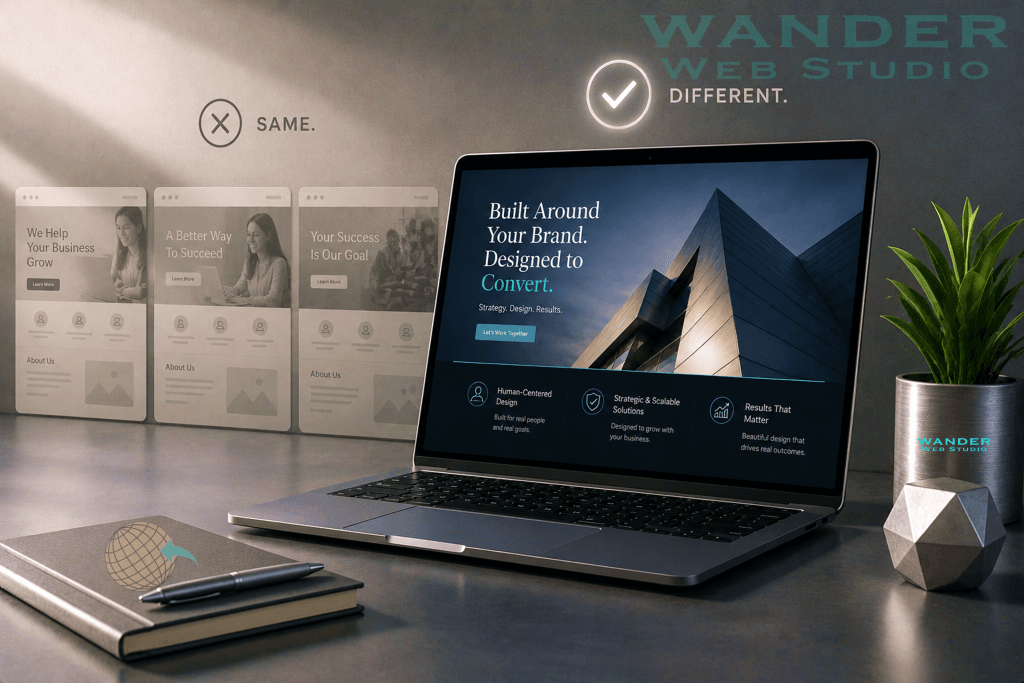
Open ten small business websites in a row right now. Go ahead, try it. Same hero section, same three-icon feature row, same stock photo of someone laughing at a laptop. It’s a little eerie, honestly. And it’s not an accident — it’s what happens when everyone reaches for the same AI-generated templates to build a site fast. Custom web design used to mean paying a designer to make something original. Now it’s starting to mean something else too: proof that a human actually thought about your brand.
I don’t think this is designers being precious about craft, either. There’s a real business cost here. When your site looks like a template — because it is one — visitors register that, even if they can’t articulate why. It reads as generic. Sometimes it reads as untrustworthy. Not great when you’re trying to convert a stranger into a customer.
Let’s walk through the signs and then talk about what to actually do about it.
This is the most obvious tell, and also the one people notice least about their own site (funny how that works). If you can picture your homepage structure without even looking at it — hero, three value props, testimonial carousel, footer CTA — there’s a decent chance a hundred other businesses in your industry have the exact same bones.
Custom web design doesn’t mean throwing out structure that works. It means building a layout around your actual content and your actual customer journey, not a template someone else optimized for a completely different business.
You know the tone. “We’re passionate about delivering excellence.” Sure. Everyone is. This is one of the clearest AI-template giveaways — vague, safe, interchangeable language that could belong to literally any company in any industry. It’s not wrong, exactly. It’s just forgettable, and forgettable doesn’t convert.
There’s a whole design conversation happening right now about pulling back from the overly polished, AI-smoothed aesthetic. Designers are actively leaning into rougher, more tactile, more obviously human-made visuals — real texture, imperfect edges, actual photography instead of a stock model smiling at a MacBook. It’s a reaction to how flooded the web has gotten with AI-generated sameness, and it’s becoming a genuine differentiator for brands willing to commit to it.
If your entire visual identity could be swapped onto a competitor’s site with zero changes, that’s worth sitting with for a second.
Here’s something most business owners never think about because it’s invisible to visitors: how your pages actually link to each other behind the scenes. Custom web design isn’t only about how a page looks — it’s about whether your service pages, blog content, and resources are organized into a logical structure that guides both users and search engines through your expertise.
We covered exactly this in our post on internal link siloing, and it applies here too — a beautifully designed page that’s disconnected from the rest of your site is still, functionally, a template mistake. Real custom design threads through the whole architecture, not just the homepage.
This one’s harder to spot because it’s about absence, not presence. Templates are built to fit anyone, which means they fit no one particularly well. If your site doesn’t have a single detail that only makes sense for your business — your process, your specific promise, your actual personality — it’s probably not really “yours.” It was borrowed.
I’ll be honest, a few years ago this argument would’ve felt a little precious, like a designer defending their own relevance. But the flood of AI-generated “vibe-coded” websites this year has genuinely changed the visual landscape of the web, and design analysts are noticing the same pattern we are: the baseline has flattened out, and standing apart from that baseline is becoming a competitive advantage in its own right, not just an aesthetic preference; see Fireart Studio’s breakdown of the shift toward what they call “tactile” and deliberately human-made design.
What stands out to me, looking across dozens of client sites, is how much of this comes down to restraint, not extra effort. Custom design doesn’t mean adding more. It means making fewer, more deliberate choices instead of accepting whatever the template defaults to.
A few things you can check today:
If most of these come back as “yeah, that’s kind of generic,” that’s not a failure — it’s just where a lot of businesses land after a few years of quick fixes and template shortcuts. It’s fixable, and honestly it doesn’t always require a full rebuild. Sometimes it’s a matter of a targeted website redesign and development pass rather than starting from scratch. Other times, especially for newer businesses, it makes more sense to start with intentional custom website building and design from the ground up.
Either way — the goal isn't to look "unique" for its own sake. It's to look like you, specifically, because that's what actually earns trust. Sameness might be fast. It's rarely memorable, and memorable is what turns a visitor into a client.
Turn your website into a high-performance business tool.
Through our parent company, Cocha Technology Inc., we are officially multi-certified as: WBE | MBE | SBE | HABE
4321 Kingwood Drive, Suite 222
Kingwood Texas 77339
Phone: 281-607-0616
Email: info@wanderwebstudio.com
Operating on Central Standard Time (CST) | Serving Clients Across All Time Zones
Copyright © Wander Web Studio. All Rights Reserved.