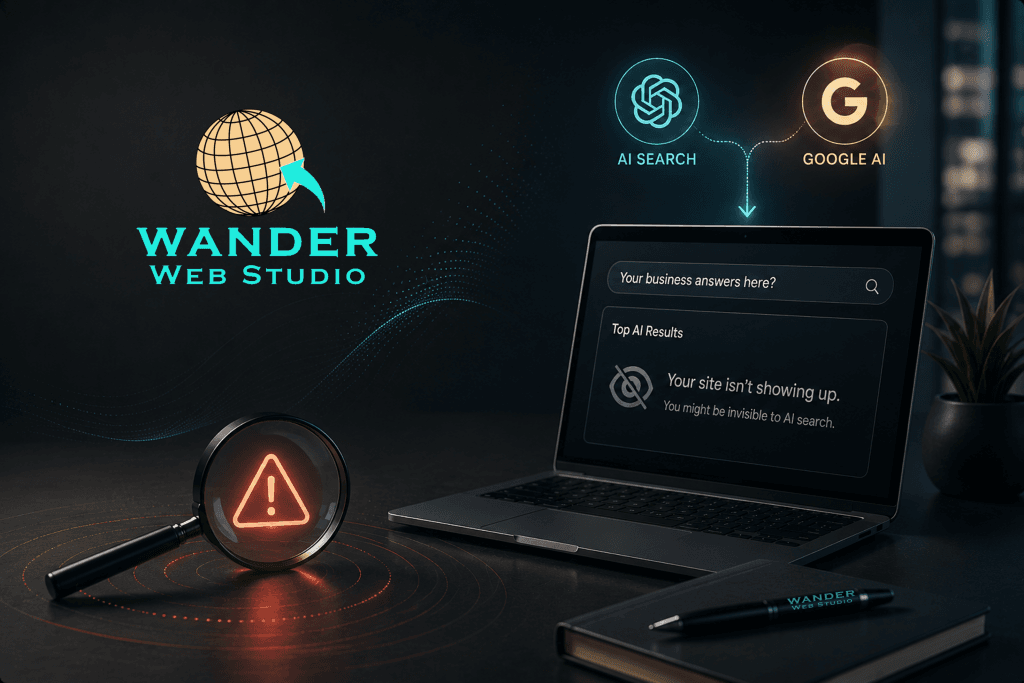
Here’s an uncomfortable question. When someone asks ChatGPT or Google’s AI Overview a question your business could answer, does your website ever show up? For a lot of Wander Web Studio clients we talk to, the honest answer is “I have no idea.” And that’s the problem. AI search optimization used to be a nice-to-have, something you’d get to eventually. Not anymore. Not in 2026.
I’ll be blunt: this shift happened faster than almost anyone predicted. Adobe’s own research tracked AI-driven referral traffic to websites jumping more than tenfold in the U.S. between mid-2024 and early 2025. That’s not a slow trend. That’s a shift in how people find businesses, period. And if your site wasn’t built with that in mind, you might be losing customers you never even knew existed.
So, let’s get into it — what does it actually look like when a website is invisible to AI search, and what can you do about it?
Old-school SEO rewarded long, meandering intros. You know the type — three paragraphs of throat-clearing before you get to the actual point. AI engines hate that. They want the answer fast, ideally in the first sentence or two under a header.
Think about it from the machine’s perspective for a second. ChatGPT, Perplexity, Gemini — they’re scanning thousands of pages trying to find the cleanest, most extractable answer to stitch into a response. If your page makes them dig, they’ll just move to the next site. Simple as that.
The fix isn’t complicated, honestly. Answer the question directly under your header, then expand. It feels almost too simple to work. It works.
This one trips up almost every small business owner I’ve talked with — schema markup sounds technical, so it gets ignored. It’s really just labels on the back end of your site that tell search engines (and AI crawlers) exactly what they’re looking at: an FAQ, a service, a review, a business address. Without it, AI models are basically guessing at context, and guessing isn’t a great way to earn a citation.
If you’ve never touched schema before, this is genuinely one of the highest-leverage, lowest-effort fixes available for AI search optimization in 2026. It won’t change what visitors see on the page. It changes what the machines understand about it.
Is there a different phone number on Google Business Profile than what’s on your site? Old address still sitting on a directory listing from three years ago? AI systems pull trust signals from all over the web, not just your homepage — and inconsistency reads as a red flag, not a small clerical error.
This is where things get interesting, and where a lot of businesses genuinely don’t realize how much damage they’re doing to themselves. AI crawlers (like traditional search engines before them) rely heavily on how your pages link to one another to figure out what topics you’re an authority on. If your blog posts, service pages, and resources are just floating out there with no relationship to one other, you’re making the crawler work way too hard.
This is exactly the strategy we broke down in our earlier post on internal link siloing — grouping related content together so search engines (and now AI engines) can trace a clear path through your site’s expertise. Skip that structure, and honestly, you’re leaving one of the easiest wins on the table. We go even deeper on the mechanics of this in our full generative engine optimization strategy guide, if you want the long version.
AI engines are picky about who they cite. They lean toward sources that feel safe — credentialed, reviewed, mentioned elsewhere on the web. If your site has no author bios, no case studies, no third-party mentions, you’re asking to be skipped over in favor of a competitor who put in that work.
This is honestly the piece most business owners underestimate the most. It’s not flashy. It’s not a redesign. It’s just — proof that you’re real and you know what you’re talking about.
I think the honest answer is: it depends how long you want to wait. Right now, in the middle of 2026, AI search is still a smaller slice of overall traffic compared to traditional Google search. But it’s growing, and growing fast, and the businesses setting up their AI search optimization foundation now are building something that compounds — every quarter they wait, a competitor gets there first and starts collecting those citations instead.
A few practical next steps, if you want to start today:
None of this requires ripping your whole site apart. It requires attention, and honestly, a bit of patience — because AI citation isn’t instant, it builds over weeks and months as engines re-crawl and re-evaluate your content.
If your website was built more than a couple years ago, there’s a decent chance it wasn’t designed with any of this in mind — and that’s not a knock on you, it’s just how fast this space has moved. Our team works through exactly this kind of audit as part of our strategic content engineering process, mapping out where your content is strong, where it’s invisible, and what order to fix things in.
For a deeper technical breakdown of how AEO differs from traditional SEO, HubSpot has a solid rundown of the strategic shift happening across the industry — worth a read if you want the bigger picture: HubSpot: Answer Engine Optimization Trends.
AI search optimization isn’t a trend you can sit out. And honestly; getting ahead of it now, while most of your competitors are still ignoring it, might be the cheapest marketing advantage you’ll find this year.
Turn your website into a high-performance business tool.
Through our parent company, Cocha Technology Inc., we are officially multi-certified as: WBE | MBE | SBE | HABE
4321 Kingwood Drive, Suite 222
Kingwood Texas 77339
Phone: 281-607-0616
Email: info@wanderwebstudio.com
Operating on Central Standard Time (CST) | Serving Clients Across All Time Zones
Copyright © Wander Web Studio. All Rights Reserved.