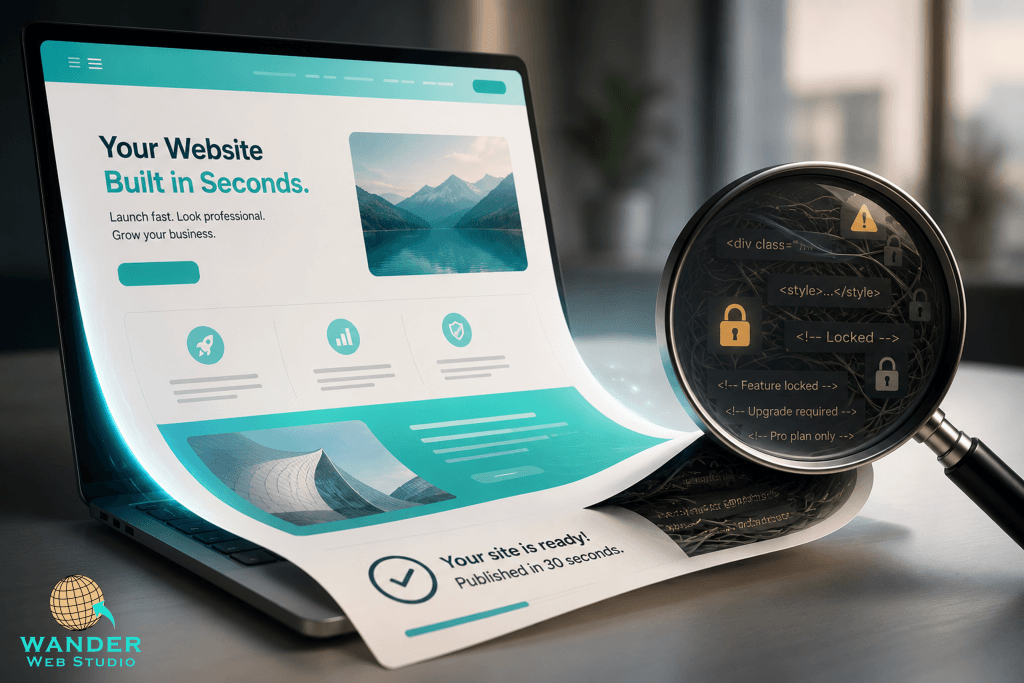
Type a few sentences about your business into an AI website builder, and in under thirty seconds, you’ve got a website. Logo, colors, layout, even some starter copy, all generated while you were still deciding what to type next. It’s genuinely impressive, and I don’t want to undersell that — the speed is real, and for some businesses, it’s exactly enough. But “impressive” and “sufficient for the long haul” aren’t the same claim, and that’s the distinction this post is about to address.
AI website builder limitations don’t usually show up on day one. They show up three months in, when you’re trying to make a specific change and discover you simply can’t, or six months in, when you realize the site that generated in thirty seconds looks a lot like several other sites that also generated in thirty seconds.
A comparison of GoDaddy Airo and Wix’s AI builder found that neither platform’s AI setup was particularly remarkable — both produce websites that function adequately but lack distinctive character. That’s not a knock on either company specifically. It’s just the nature of the tool. An AI generating a site in seconds is drawing from patterns it’s seen thousands of times before, which means the output tends toward “generic but functional,” almost by definition.
Most AI builders let you swap colors, fonts, and text easily enough. What’s harder to change is the underlying structure the AI decided on for you. GoDaddy Airo specifically has been described as using a rigid grid system — one that prevents your site from “breaking,” but also prevents genuinely unique layouts, since you’re working within pre-set sections rather than placing things freely. If your vision for the site doesn’t match the AI’s initial assumptions, you may find yourself with far less room to adjust than you expected.
This is the piece that surprises people most, honestly, and it deserves its own point because of how significant it is. Some AI and drag-and-drop builders run on proprietary systems where users simply cannot export their code at all. Practically speaking, that means your website exists entirely inside someone else’s platform. You didn’t write the code, you often can’t see the code, and if you ever want to move your site elsewhere — to a different host, a different developer, a genuinely custom build — there may be no clean way to bring it with you. You’re not just choosing a builder. You’re choosing a landlord.
At some point, most growing businesses need something a little outside the standard template — a tracking pixel for a specific ad platform, a third-party booking widget, a small custom feature a competitor doesn’t have. Reviews of GoDaddy Airo specifically note that if you need to add a tracking pixel, embed a third-party widget, or tweak anything at the code level, the platform simply doesn’t allow it. That’s not a hypothetical edge case. It’s the kind of thing that comes up constantly once a business starts marketing itself seriously.
Most AI builders include some form of built-in SEO assistant, and it’s usually fine for the absolute basics. But “fine for basics” and “built to actually compete” are different standards. One detailed review found that while GoDaddy’s SEO Wizard helps novices, it lacks the depth required for competitive ranking — advanced technical controls like schema markup or complex URL structuring are largely absent. If you’ve read our earlier posts on this blog about how much structure and technical SEO now matter, both for traditional search and for AI answer engines, this gap becomes a real problem, not a minor inconvenience.
Pricing on these tools is genuinely appealing at first glance — several options run well under what a custom build would cost. But affordability only tells part of the story. If the limitations above mean you eventually need to migrate to something more flexible anyway, the “affordable” option becomes the first of two payments instead of the only one. It’s worth asking, honestly, whether the goal is the cheapest starting point, or the option that honestly gets your business where it’s trying to go without a costly detour in the middle.
One thing worth untangling here, since it trips people up: hosting platforms and AI website builders are not the same category of tool, even though they sometimes get lumped together. A platform like Cloudways, for example, is managed cloud hosting — it’s where a website lives and runs, not a tool that generates the website itself. Hosting is the foundation; a builder (AI-powered or otherwise) is what actually creates what sits on top of it. Knowing the difference matters when you’re evaluating options, since solving your hosting doesn’t solve the question of who — or what — is truly building your site.
To be fair, these tools aren’t wrong for everyone. If you need a basic, functional web presence immediately, on a tight budget, with modest long-term ambitions for the site, an AI builder can be a completely reasonable choice — arguably a better one than no website at all. The limitations above matter most for businesses planning to grow, market aggressively, or eventually need something the template-based system simply wasn’t built to accommodate.
If you’ve already got a site built this way and you’re recognizing some of these limitations, that’s not a sign you made a bad call. It’s a sign your business has grown past where the tool was ever meant to take you — which is a good problem, honestly, even if it doesn’t feel like one in the moment. This is exactly the kind of transition our website redesign and development service is built for, moving a business off a locked, limited platform and into something you genuinely own and control.
Owning your site’s actual code and structure also connects to how well it can be organized long-term — something like internal link siloing simply isn’t possible to implement properly on a platform that restricts how your content and pages can be structured in the first place.
AI website builder limitations aren’t really about the technology being bad. To be honest, the technology is often genuinely impressive. It’s about matching the tool to how far you envision and plan to take your business, and being honest with yourself about which one you’re really choosing.
Templates and AI builders both come with trade-offs you at least have some control over. In our next post, we’re covering something with far less flexibility built in — proprietary, industry-specific platforms where getting even a small update made can turn into a genuine ordeal, straight from a real client experience.
Turn your website into a high-performance business tool.
Through our parent company, Cocha Technology Inc., we are officially multi-certified as: WBE | MBE | SBE | HABE
4321 Kingwood Drive, Suite 222
Kingwood Texas 77339
Phone: 281-607-0616
Email: info@wanderwebstudio.com
Operating on Central Standard Time (CST) | Serving Clients Across All Time Zones
Copyright © Wander Web Studio. All Rights Reserved.