In part 1 we walked you through where E-E-A-T tends to be missing on a lot of small business sites. If you ran through that self-check and found a few gaps, that’s completely normal — this isn’t something most businesses build on purpose from day one. It tends to happen gradually, or not at all, depending on how deliberately you approach it. Building website E-E-A-T is genuinely doable, though, and it doesn’t require reinventing your entire site. It requires being specific about proof, in a handful of concrete places.
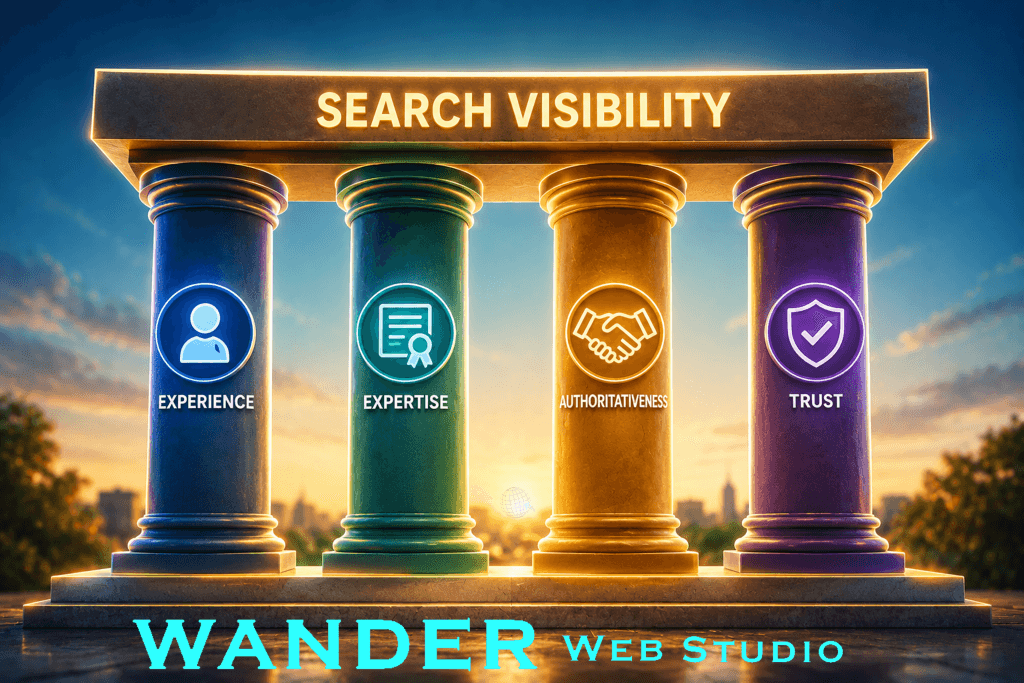
Let’s go through each pillar and what actually strengthens it.
Vague claims like “years of experience” or “trusted by many” don’t do much on their own — anyone can write those words. What demonstrates experience is specificity: a case study with real details, a process you walk through step by step, photos of actual work rather than stock imagery, a story about a mistake you learned from. The goal is content that couldn’t have been written by someone who merely researched your industry instead of working in it.
If you’re certified, credentialed, or simply have a strong track record, that needs to live somewhere visible on your site, not just be true in the background. An About page listing real qualifications, a services page that explains your actual process in detail, even a simple “why we do it this way” section — these turn expertise from an assumption into something a visitor (and a search engine) can actually verify.
This is the pillar that takes the longest, honestly, because it’s the one built outside your own website. A few realistic starting points: ask happy clients for reviews consistently, reach out to local publications or industry sites about being featured, look for genuine partnership or guest-posting opportunities in your space. None of this needs to happen overnight. It’s a slow accumulation, but it’s a real one, and it compounds over time in a way self-published claims never can.
This one’s simple and high-impact, and we’ve written about it directly before — a genuine name and short bio behind your content does more for trust than people expect, and its absence is a specific, fixable gap. If your blog posts or pages are currently published under something generic like “admin,” that’s one of the fastest wins available in this entire list. It costs nothing but a little time to fix.
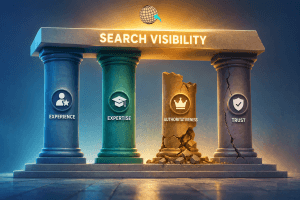
Clear contact information. A real About page that explains who runs the business. Visible security signals like SSL. Honest, accurate content that doesn’t overstate or mislead. These build the trust pillar Google’s own guidelines describe as the most important of the four (source: SEO-Kreativ, E-E-A-T Guide 2026) – and importantly, this is the one pillar you have almost complete control over, unlike authoritativeness, which depends partly on others.
If you’re building website E-E-A-T from a relatively blank starting point, here’s a reasonable sequence:
None of these require a website rebuild. Most of them are content and process changes you can layer onto your existing site, gradually, without disrupting anything that’s already working.
Structure matters here too, worth repeating from Part 1 — a well-organized site built around clear internal link siloing reinforces expertise on its own, since a connected cluster of in-depth content on a subject reads as far more authoritative than the same information scattered across unrelated, disconnected pages.
The businesses genuinely investing in this now are building something that compounds, quietly, over months and years, while competitors who skip it are left with thin, forgettable content that both search engines and visitors are increasingly good at recognizing as such. This isn’t a trend that’s likely to reverse — if anything, as more of the web fills with AI-generated content, genuine, verifiable credibility becomes a sharper differentiator, not a smaller one.
If building this out feels like more than you want to tackle solo, that’s a fair, common place to be — this kind of ongoing content strategy work is exactly what our strategic content engineering service is built around, helping map out where your credibility gaps actually are and building a realistic plan to close them over time.
Building website E-E-A-T isn’t a one-time project with a finish line. It’s closer to a standard you hold your content to going forward — every new page, every new post, built with real experience, visible expertise, honest transparency, and a little patience for the outside recognition piece to grow. Get that foundation in place, though, and it becomes one of the more durable advantages a small business can build online.
Turn your website into a high-performance business tool.
Through our parent company, Cocha Technology Inc., we are officially multi-certified as: WBE | MBE | SBE | HABE
4321 Kingwood Drive, Suite 222
Kingwood Texas 77339
Phone: 281-607-0616
Email: info@wanderwebstudio.com
Operating on Central Standard Time (CST) | Serving Clients Across All Time Zones
©2026 Wander Web Studio. All Rights Reserved.