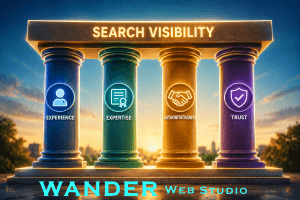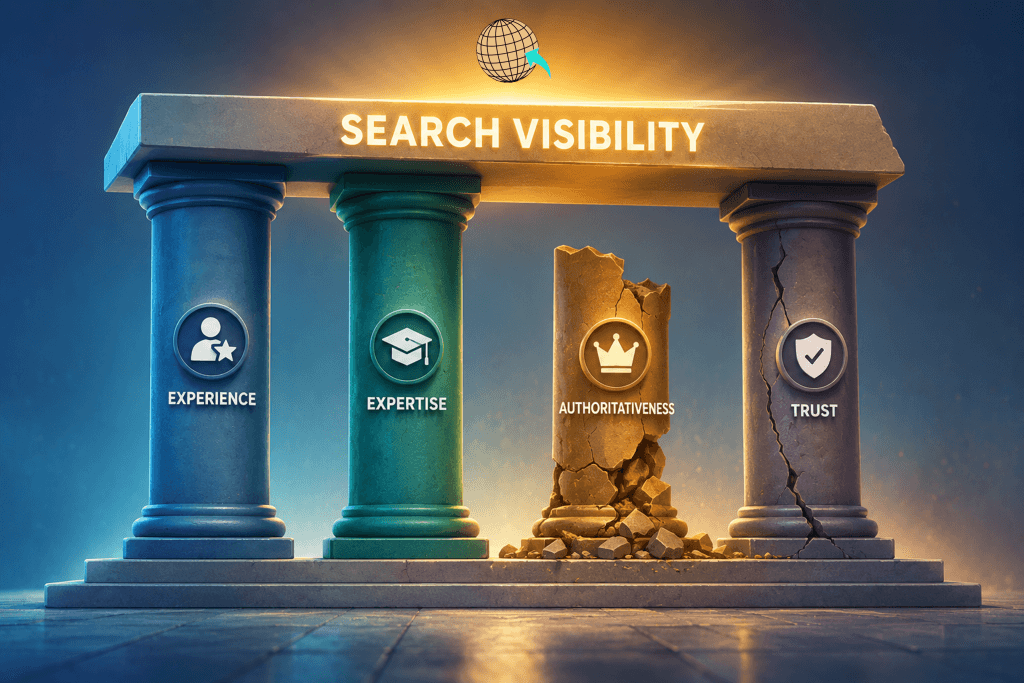
If you’ve never heard the term E-E-A-T, you’re honestly not alone — a lot of business owners haven’t, even though it’s been quietly shaping how Google evaluates content for years now. It stands for Experience, Expertise, Authoritativeness, and Trust, and it comes straight from Google’s own Search Quality Rater Guidelines — the document human evaluators use to judge whether a page deserves to rank. It’s not a single, isolated ranking factor you can just tick off. It’s closer to a lens Google applies across your whole site, asking one underlying question: can this honestly be trusted?
Website E-E-A-T matters more now than it used to, and there’s a specific reason for that. As AI-generated content floods the web, distinguishing a genuinely credible source from something that just looks polished has become a much bigger priority for search engines — and increasingly, for the AI tools built on top of them too.
Let’s walk through where this tends to be missing.
This is the newest of the four letters, added in 2022 specifically to separate genuine, firsthand experience from content that’s merely researched secondhand. If your content reads like it could’ve been written by anyone, about anyone’s business, without a single detail that only makes sense coming from someone who’s done the work — that’s a genuine gap. Real experience shows up in specifics: a process you follow, a mistake you’ve actually seen clients make, a detail that couldn’t have come from research alone.
Expertise is about demonstrated competence — and “demonstrated” is the key word. It’s not enough to be good at what you do if nothing on your site truly shows it. Certifications, years of experience, specific results you’ve delivered, a clearly stated process: these are the things that let both a visitor and a search engine judge whether you, in truth, know what you’re talking about, rather than just claiming to.
This is the piece a lot of businesses miss entirely, because it’s the one part of E-E-A-T that isn’t fully in your control. Authoritativeness isn’t about what you say about yourself — it’s about what others recognize about you. Mentions in local press, backlinks from other credible sites, reviews, partnerships, industry recognition. If literally nothing on the internet references your business except your own website, that’s a real gap in this pillar specifically.
We touched on this in an earlier post in this series, but it belongs here too, front and center. A named author with a real bio does more for trust than most business owners expect, and its absence is a direct, specific gap in the “Trust” pillar of E-E-A-T. Anonymous “admin” posts or unattributed pages read as exactly the kind of thin, unaccountable content that both human readers and search evaluators are trained to be skeptical of.
Trust, according to Google’s own guidance, is the pillar the other three ultimately rest on — described in the Quality Rater Guidelines as the most important member of the E-E-A-T family. A clear “About” page, visible contact information, transparency about who runs the business and how to reach a real person — these aren’t just customer-service nice-to-haves. They’re core credibility signals. A site that’s vague or hard to pin down on basic questions like “who actually runs this” undermines trust before a visitor ever reads your actual content.
It might seem odd that a framework introduced back in 2014 would matter more now than ever, but the reasoning holds up. As AI-generated content becomes easier to produce at scale, the content that looks superficially polished but has no real substance behind it is becoming much more common — and much easier for both Google’s systems and AI search tools to spot. A well-organized, genuinely substantive site increasingly stands out more, not less, in that environment, because so much of what surrounds it online is thinner than it looks.
This connects directly to something we’ve written about elsewhere on this blog — a site with clear internal link siloing doesn’t just help search engines navigate your content. It also reinforces expertise, since a well-organized cluster of related, in-depth content on a subject is a much stronger authoritativeness signal than the same information scattered across disconnected, unrelated pages.
Here are just a few honest questions worth sitting with:
If several of those gave you pause, that’s a genuinely common place to be — E-E-A-T isn’t something most businesses set out to build deliberately. It tends to accumulate, or fail to, as a byproduct of everything else. The good news is that it’s built from concrete, specific pieces, not some abstract quality that’s hard to pin down. Part 2 of this post will walk you through exactly how to strengthen each pillar, practically, without needing a total content overhaul.
For now, the main thing worth taking away is this: website E-E-A-T isn’t a technical SEO checkbox sitting off to the side. It’s a direct reflection of whether your site realistically proves what it claims — and increasingly, that proof is what determines whether you show up at all.
Turn your website into a high-performance business tool.
Through our parent company, Cocha Technology Inc., we are officially multi-certified as: WBE | MBE | SBE | HABE
4321 Kingwood Drive, Suite 222
Kingwood Texas 77339
Phone: 281-607-0616
Email: info@wanderwebstudio.com
Operating on Central Standard Time (CST) | Serving Clients Across All Time Zones
©2026 Wander Web Studio. All Rights Reserved.