You’ve typed some version of this into Google — or asked ChatGPT, let’s be honest — at least once this week: how much should a website actually cost? And you probably got three wildly different answers. $500. $5,000. $50,000. All “correct,” depending on who’s answering and what they’re trying to sell you.
I’m going to give you the real range, what drives it, and where most small businesses actually land. No funnel, no “book a call to find out.” Just the numbers.
Website cost isn’t really one number — it’s a handful of decisions stacked on top of each other. How many pages. Whether it’s custom-built or templated. Whether someone’s doing SEO work underneath it or just making it look nice. Whether you need e-commerce, booking tools, a client portal, that sort of thing.
Here’s the part nobody tells you upfront: the sticker price and the real cost are often two different things. A $600 DIY site and a $15,000 custom build can both say “website” on the invoice, but they are not the same product. Not even close.
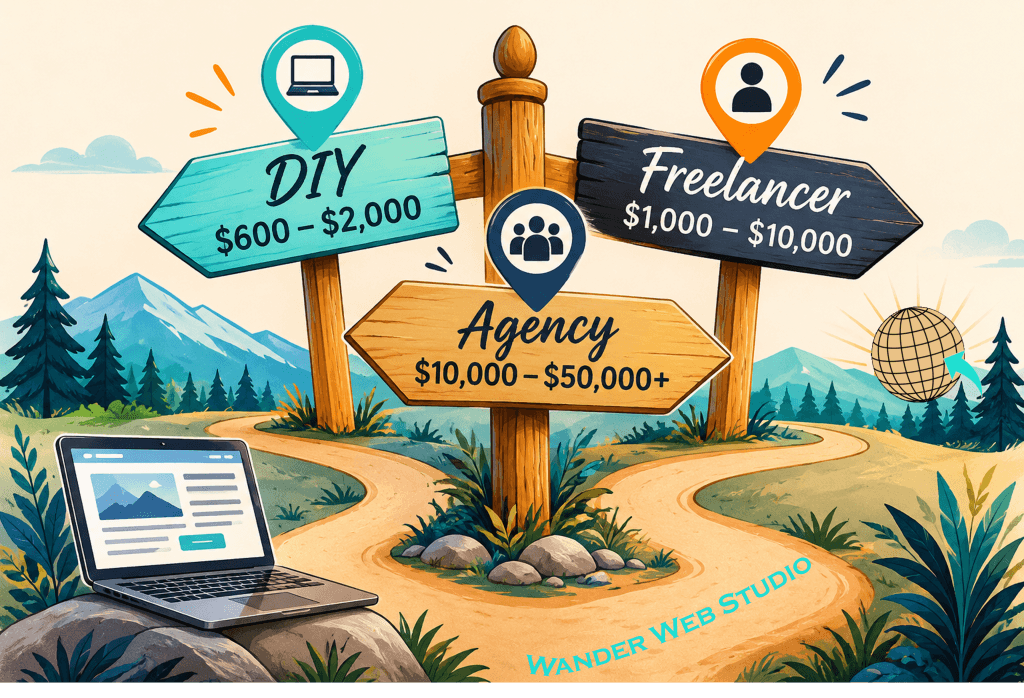
If you’re building it yourself on something like Wix or Squarespace, you’re looking at roughly $4–$40 a month for hosting and the builder itself, plus about $10–$30 a year for a domain name. All in, maybe $600 a year. Cheap, no argument there.
The catch — and there’s always a catch — is time and ceiling. You’re the designer, the copywriter, the SEO person, and the person who has to figure out why the mobile version looks broken, all at once. And DIY builders hit a ceiling fast: once you need something custom (real automation, deeper SEO structure, a site that can scale with you), you’re often rebuilding from zero anyway. I’ve seen that happen more than once.
A freelancer will typically run $1,000–$3,000 for a simple site, sometimes more depending on scope and how in-demand they are. You get more customization than DIY, a real human who (hopefully) knows what they’re doing, and a lower price tag than an agency.
What you’re gambling on is consistency. A freelancer juggling six clients might not have the bandwidth — or the systems — to keep your site fast, secure, and SEO-sound six months after launch. That’s not a knock on freelancers, honestly; it’s just the structural reality of being one person.
Agency pricing runs wide — anywhere from $10,000 to $50,000+, depending on scope. That’s a big range, I know. What narrows it is what’s actually included: strategy, custom design (not a theme with your logo slapped on), technical SEO built into the foundation, and ongoing support after launch.
This is where I’ll be straightforward, because it’s my own business and I think transparency matters more than most agencies act like it does. Our custom website design packages start at $2,500 for a focused 3–5 page site and scale up from there — well under that typical agency ceiling, because we don’t pad in a layer of account managers and overhead you never actually benefit from. What you do get at every tier: mobile-responsive design, SSL, and an SEO foundation baked in from day one, not bolted on after the fact.
Here’s what actually inflates a quote, and what doesn’t always show up until you’re mid-project:
A website isn’t a one-time purchase, really — or it shouldn’t be treated like one. It needs updates, security patches, speed monitoring. A site that looked great at launch and gets ignored for two years tends to slide into exactly the kind of slow, revenue-draining mess that quietly costs you more in lost business than the build ever cost upfront.
Sometimes. Not always — I won’t pretend every small business needs a $20,000 site, because plenty don’t. But the data on this is pretty blunt: 94% of people cite web design as the reason they distrusted or rejected a website, and half of consumers say their entire impression of a business hinges on how its website looks and functions. That’s not a vanity metric. That’s lost customers, measured.
So the real question isn’t “what’s the cheapest website cost I can find.” It’s “what’s the cheapest website cost that still makes someone trust me enough to pick up the phone.” Those are different questions with very different answers.
A few things that actually move the number without wrecking the result:
At the end of the day, website cost is really a question of what you’re trying to get back from it. A site that brings in even one or two extra clients a month pays for itself fast, regardless of which number was on the invoice. If you want a straight answer on what your specific project would actually run — no inflated quote, no pressure — reach out and we’ll walk through it together.
Turn your website into a high-performance business tool.
Through our parent company, Cocha Technology Inc., we are officially multi-certified as: WBE | MBE | SBE | HABE
4321 Kingwood Drive, Suite 222
Kingwood Texas 77339
Phone: 281-607-0616
Email: info@wanderwebstudio.com
Operating on Central Standard Time (CST) | Serving Clients Across All Time Zones
©2026 Wander Web Studio. All Rights Reserved.