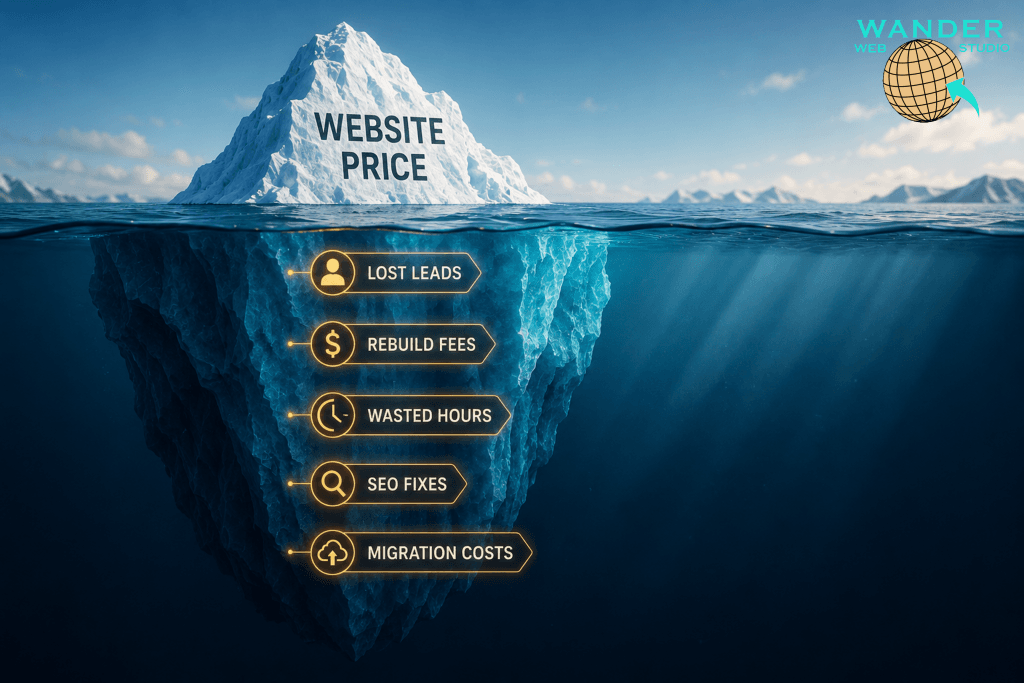
Let’s do some actual math today, because I think this whole series has been circling around a number nobody’s put directly on the table yet. Everything we’ve covered — templates, AI builders, vendor lock-in, how to vet a developer — all of it eventually comes back to the same underlying tension: the sticker price of a website and the real cost of a cheap website are frequently two very different numbers, and the gap between them tends to show up later, quietly, in places you’re not watching.
I want to walk through where that gap usually hides, with real numbers, not just a vague warning to “invest in quality.”
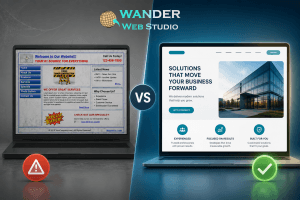
A detailed breakdown of website redesign costs found that low-cost options — template builds, bargain freelancers, “fast and cheap” agencies — look attractive at first glance, but the real cost of a website isn’t in the initial build. It’s in how well, or how poorly, that site performs over the next three to five years. A $750 site and a $6,000 site aren’t two versions of the same product being compared on price. They are two different outcomes being compared on a number, and the number alone doesn’t tell you which one you’re actually getting.
Here’s a concrete example worth sitting with. One case involved a business that paid $750 for a site from a developer who tested it exclusively on a desktop monitor — meaning the mobile experience was, functionally, broken. Text overlapped images. Buttons were nearly impossible to tap accurately. The eventual redesign cost $6,000, and it increased the business’s conversion rate to 4.2 percent overnight — roughly fourteen times better performance, purely from making the site actually usable on the devices customers were really using. The original $750 wasn’t a cheap or affordable answer. It was a down payment on a $6,750 total, with a broken website sitting in between.
This is the piece that’s easiest to overlook, because it never shows up on an invoice at all. Cheap website builds tend to have an expiration date — they hit their limits fast, whether by being outgrown, becoming too frustrating to maintain, or simply breaking down, which means going through the whole redesign process again sooner than expected. Each redesign cycle can eat up 20 to 40 hours of a business owner’s own time. Valued conservatively at $75 an hour, that’s $1,500 to $3,000 in opportunity cost, per cycle — and over five years, a business on the cheap-and-repeat path might go through two or three of those cycles, while a properly built custom site is still going strong the whole time. That’s real money, even if it never appears on an invoice — it’s just paid in hours instead of dollars.
This one compounds in a way that’s easy to miss until you’re deep into it. Many budget website builders restrict URL structure — forcing generic paths instead of clean, keyword-rich URLs — which matters directly, since URL structure is itself a ranking signal. Layer on top of that the extra scripts and frameworks many budget builders load behind the scenes, slowing page speed, and you’ve got a site quietly working against its own visibility from day one. The cost here isn’t a line item. It’s the customers who could have found you organically and simply never did, month after month, without you ever seeing exactly what you missed.
If you ever redesign a cheap site — and per the pattern above, most eventually do — there’s another cost waiting that inexpensive vendors routinely leave out entirely: proper content migration. This involves far more than copying and pasting text between platforms; inexpensive vendors typically exclude migration altogether or cap it at an unrealistically small number of pages, leaving the business to scramble or hire additional help later, increasing the total cost anyway. Poor migration also puts your existing SEO equity and brand consistency at risk in the process.
It’s worth showing the upside directly, not just the downside, because the case for investing properly isn’t just “avoid pain” — it’s genuinely additive. Research compiling data across 42 web redesign projects found average usability improvements of 135 percent, with conversion rates roughly doubling on average following a professional redesign. Speed matters here too, concretely — mobile visitors abandon a page at a 53 percent rate once load time crosses three seconds, according to Think with Google’s research, which means a well-built site isn’t just nicer to use, it’s directly protecting revenue that a slow, cheap build would otherwise be quietly losing.
I don’t think it’s honest to say never. If you’re testing a genuinely new business concept and need something minimal just to validate the idea exists before investing further, a cheap or free option can be a completely reasonable starting point — as long as you go in with eyes open about its limits and its likely shelf life. The real problem isn’t choosing cheap. It’s choosing cheap without realizing there’s a second bill coming later, one you didn’t budget for because nobody showed you the math upfront.
If you’re weighing this decision right now, it’s worth laying it out plainly:
None of this is about fearmongering toward the expensive option automatically. It’s about making sure the comparison you’re actually making is the real one — total cost over three to five years, not just the number on the first invoice.
This is exactly the kind of long-term thinking behind our website building and design and website redesign and development services — built to be a durable asset rather than the first of several bills. Part of that durability comes from structure, too — a properly built site supports meaningful practices like internal link siloing in a way a rushed, budget build often can’t sustain as it grows.
The cost of a cheap website was never really about the invoice. It’s about which number you’re comparing — and once you see the full one, the decision tends to look a lot different than it did at first glance.
We’ve covered what goes wrong, how to vet the right partner, and what cheap actually costs over time. In our final post, we’re pulling it all together — why the healthiest relationship with your website isn’t a one-time purchase, but an ongoing partnership that grows alongside your business.
Turn your website into a high-performance business tool.
Through our parent company, Cocha Technology Inc., we are officially multi-certified as: WBE | MBE | SBE | HABE
4321 Kingwood Drive, Suite 222
Kingwood Texas 77339
Phone: 281-607-0616
Email: info@wanderwebstudio.com
Operating on Central Standard Time (CST) | Serving Clients Across All Time Zones
Copyright © Wander Web Studio. All Rights Reserved.