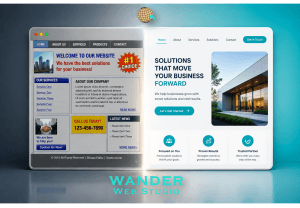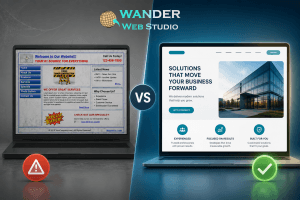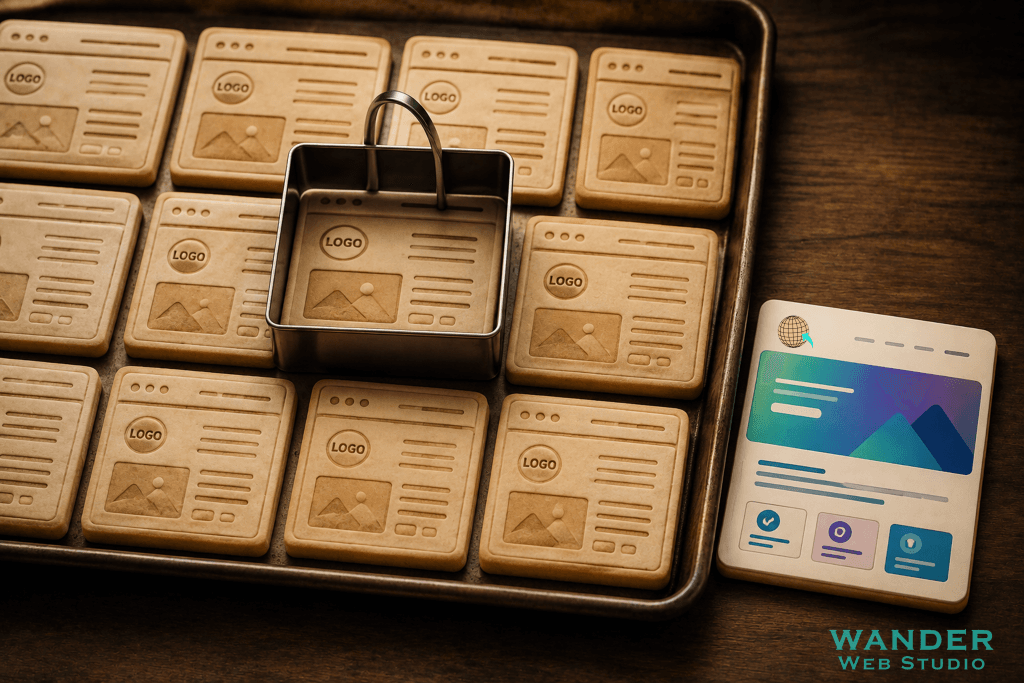
Somewhere out there, right now, three or four other businesses in your exact industry are using the same website template you’re considering. Maybe the same one you already have. Different logo, different colors maybe, but underneath — same bones, same layout, same “here’s our team” section in the same spot it always is. That’s not a knock on you for picking it. Templates are everywhere because they work, sort of, in the narrow sense of “a website exists now.” But working in that narrow sense and working for your business aren’t the same thing, and that gap is what this post is about.
DIY website templates promise speed and savings, and to be fair, they deliver both. What they don’t advertise quite as loudly is what you’re trading away to get there.
Here’s the thing about templates — the entire business model depends on thousands of people using the exact same design. That’s how the company selling it makes money. Which means the odds that your competitor, or your competitor’s competitor, picked the same theme are honestly pretty high. I’ve pulled up business websites in the same city, same industry, and caught myself doing a double take because the layout was identical down to the button placement.
Digital Silk’s research on this found that 60 percent of consumers say usability directly shapes how they perceive a brand — and usability, in their framing, is tied closely to customization and brand-specific design choices, not just whether buttons technically work. A generic template isn’t neutral. It’s actively working against the impression you’re trying to make.
Most templates let you swap colors, upload a logo, maybe rearrange a section or two. That feels like customization, and technically it is — but it’s surface-level. The underlying structure, the way content is organized, the user flow guiding someone from “just looking” to “ready to contact you” — that’s mostly locked in by the template itself. If your business has a genuinely different sales process than the template assumed (and most do, once you dig into specifics), you’re stuck bending your actual business around a structure that wasn’t built with you in mind.
Templates are built to be flexible enough for thousands of different use cases, which sounds good until you realize what that flexibility costs under the hood. A lot of unused code, unnecessary scripts, features you’ll never touch — all of it still loading, still adding weight, still slowing your site down in ways a purpose-built site wouldn’t carry. You don’t see this part. It’s not visible in the preview. It just quietly shows up later as sluggish load times nobody can quite explain.
This is the one that tends to surprise people the most, honestly, because it doesn’t show up on day one. A template that fits your business fine at launch can become a real constraint two or three years later, once you’ve added services, expanded locations, or just grown more complex than the original template anticipated. At that point you’re not customizing anymore — you’re fighting the template’s assumptions every step of the way or starting over completely.
Scalify’s research on this pattern found that 68 percent of businesses that outgrow a template website eventually migrate to a custom solution anyway. That’s not a small minority hitting an edge case. That’s most businesses, eventually, running into the same ceiling.
Templates advertise themselves on price, and the sticker price genuinely is lower. But that comparison usually only accounts for the build, not what happens after. If you outgrow it and migrate later — and per the stat above, most businesses do — you’re paying for the original build, then paying again for a custom one, plus dealing with the actual cost of migration: redirects, restructured content, and often a temporary hit to your search rankings while everything resettles. Sometimes the “cheaper” option upfront is the more expensive one by the time the whole story plays out.
I don’t think it’s honest to pretend templates are never the right call — they’re not. If you need something live in days rather than weeks, if your budget is genuinely tight and a template is the difference between having a web presence and having none at all, or if your needs are simple and likely to stay that way, a template can be a completely reasonable starting point. The problem isn’t templates existing. The issue is businesses staying on one well past the point where it fits, simply because nobody flagged that the ceiling was there in the first place.
If brand differentiation matters to you — and for most service businesses, it genuinely does, since the website is often a stranger’s first real impression of who you are — a few things worth asking before committing to any option:
This connects to something we care about structurally, too — a site built with a deliberate, custom architecture makes practices like internal link siloing far more effective, since the content structure is designed around your actual business rather than retrofitted into a template’s predetermined shape.
If you’re weighing this decision right now, our website building and design service starts with exactly these questions — not a template swap, but a build that is shaped around how your specific business actually operates and where you’re headed.
DIY website templates aren’t a bad decision, exactly. They’re a decision with a shelf life and knowing that going in changes how you plan for what comes after.
Templates are only half the DIY story. In our next post, we’re digging into the newer, flashier option — AI website builders — and what’s really happening behind that “site generated in twenty minutes” promise, including code you may never actually see or understand.
Turn your website into a high-performance business tool.
Through our parent company, Cocha Technology Inc., we are officially multi-certified as: WBE | MBE | SBE | HABE
4321 Kingwood Drive, Suite 222
Kingwood Texas 77339
Phone: 281-607-0616
Email: info@wanderwebstudio.com
Operating on Central Standard Time (CST) | Serving Clients Across All Time Zones
Copyright © Wander Web Studio. All Rights Reserved.