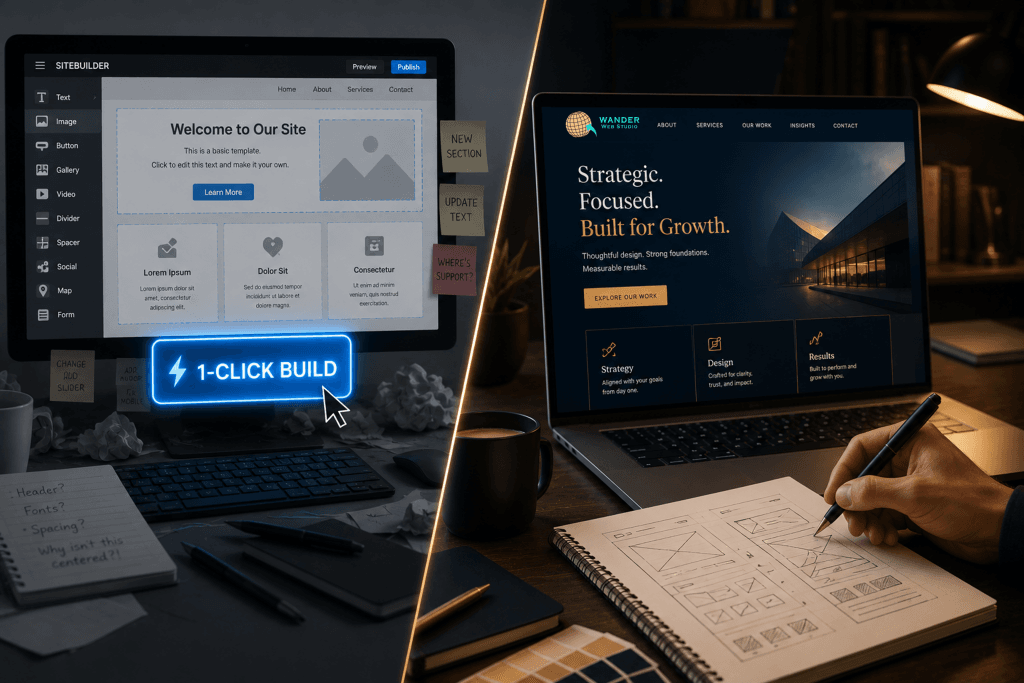
There’s a moment a lot of business owners hit, usually late at night, staring at a laptop screen. You need a website. You need it now-ish, or at least soon, and somewhere along the way someone mentioned you can just… build one yourself. A template, a drag-and-drop tool, maybe one of those AI builders that promise a finished site in twenty minutes. Tempting, right? It sounds fast. It sounds cheap. And for a lot of people, it feels like the responsible choice — why pay someone else when you can just do it?
I get the appeal. I really do. But here’s what I want to spend the next few posts unpacking with you: the gap between “a website exists” and “a website actually works for your business” is bigger than most people expect going in. And it’s a gap that tends to show up months later, quietly, in ways that are harder and more expensive to fix than if you’d started differently.
So that’s what this series is about. Over the next several posts, we’re going to walk through exactly why so many businesses eventually outgrow — or get burned by — the shortcut path, and why choosing to hire a web developer from the start (or switching to one once you realize the DIY route isn’t cutting it) tends to pay for itself many times over.
This isn’t a new debate, exactly, but it’s gotten more complicated lately. A few years ago, “DIY vs. professional” mostly meant template builders like Squarespace or Wix versus a custom-coded site. Now there’s a third option crowding in — AI website builders that promise to generate an entire site from a short questionnaire, no design or coding knowledge needed at all. More options, in theory, should make this easier. In practice, I think it’s made the decision murkier, because the shortcuts look more convincing than they used to.
The data backs up what a lot of designers have felt anecdotally for years. Case studies compiled by Appco Software found that businesses moving from a template to a custom-built website saw conversion rate improvements between 20 and 40 percent — in one specific case, a brand’s conversion rate roughly doubled after making the switch, from 2 percent to 4.2 percent, on the exact same traffic. Same visitors. Same ad spend. Nearly double the revenue, just from how the site itself was built.
That’s not a small margin. That’s the difference between a website quietly working for you and one that’s leaving real money on the table.
I want to be upfront about what’s coming, so you can decide which parts matter most to you, or just follow along in order — either works.
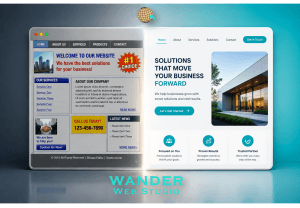
We’ll dig into why template-based websites — even nicely designed ones — tend to produce that “I’ve seen this exact layout somewhere before” feeling in visitors, and why that cookie-cutter quality does more damage to a brand than most business owners realize going in.
This is the newer, trickier one. AI-powered builders like Wix ADI, GoDaddy Airo, Durable, and similar tools have gotten genuinely impressive at spitting out a passable-looking site fast. What we’ll get into is what’s happening underneath that speed — code you may not have access to or understand, limitations on how deeply you can actually customize things, and a real conversation about whether “affordable” and “sufficient” mean the same thing here. Spoiler: not always.
This one comes from firsthand experience with a client, and it’s honestly one of the more frustrating patterns we’ve seen. Some industries — insurance is a good example — have entire proprietary platforms built specifically for them, and getting even a small update made can turn into a multi-week ordeal because you don’t truly control the system your site lives on.
We’ll wrap the series by pulling all of it together — why the healthiest relationship with your website isn’t “build it once and forget it,” but an ongoing partnership that evolves as your business does.
Honestly? Because I think it’s the conversation that should happen before all the tactical stuff — the SEO tips, the design trends, the speed optimization advice we usually write about. None of that matters much if the foundation underneath it is something you don’t control, or something that was never built to grow with you in the first place. You should hire a web developer who understands that from day one, and a lot of the problems we’ll cover later in other posts on this blog simply don’t happen to begin with.
There’s a version of this conversation that sounds like a sales pitch, and I want to be honest that there’s some of that here — we’re a web design and development studio, obviously we think this work is valuable. But there’s also a genuinely practical case underneath it, backed by real numbers, not just our own opinion. Rooted Web’s research on this makes the point plainly: template sites are quick and inexpensive upfront, but they often limit growth, flexibility, and brand differentiation exactly as a business starts scaling — which is usually the worst possible time to discover your website can’t keep up.
If you already have a website — DIY, template, AI-built, whatever — this series isn’t meant to make you feel behind or foolish for the choice you made. A lot of good, smart business decisions start with the fastest, cheapest path available at the time. That’s not a mistake. It’s just often a starting point, not a finish line. What matters is recognizing when the site you started with has stopped matching where your business actually is now.
This entire series lives together on our blog, connected and organized so you can move through it in order or jump to the piece that’s most relevant to your situation right now — the same kind of intentional internal link siloing we talk about with clients, applied to our own content too. If you’re further along and ready to talk specifics, our website building and design and website redesign and development services are exactly where a lot of these conversations end up going.
On Thursday, we will start where most of these decisions begin — with the template.
In our next post, we’re digging into the DIY template trap — why that “clean, professional, generic” feeling so many template sites share is actively working against your brand, even when the template itself looks perfectly nice on its own.
Turn your website into a high-performance business tool.
Through our parent company, Cocha Technology Inc., we are officially multi-certified as: WBE | MBE | SBE | HABE
4321 Kingwood Drive, Suite 222
Kingwood Texas 77339
Phone: 281-607-0616
Email: info@wanderwebstudio.com
Operating on Central Standard Time (CST) | Serving Clients Across All Time Zones
Copyright © Wander Web Studio. All Rights Reserved.