If you feel like you are playing a losing game of “keyword whack-a-mole,” it is because the rules of search changed while most people were looking at their rank trackers. In the early 2020s, you could pick a phrase, use it five times in a blog post, and hope for the best. But in 2026, search engines have matured beyond recognition. They no longer look for mere strings of letters; they look for Topics Over Keywords.
This shift represents a move toward quality, depth, and human-centric expertise. With the explosion of AI-generated content, the internet is saturated with thin, repetitive text. Search engines like Google and Bing have responded by prioritizing “Topical Authority”—the proof that a website isn’t just “mentioning” a subject but fundamentally understands it.
Semantic search is the cornerstone of modern SEO. It means that Google’s AI (and other generative search engines) is trying to understand the intent and context behind a query rather than just matching words. It wants to know if you are a definitive authority or just a passerby with a high-volume keyword tool.
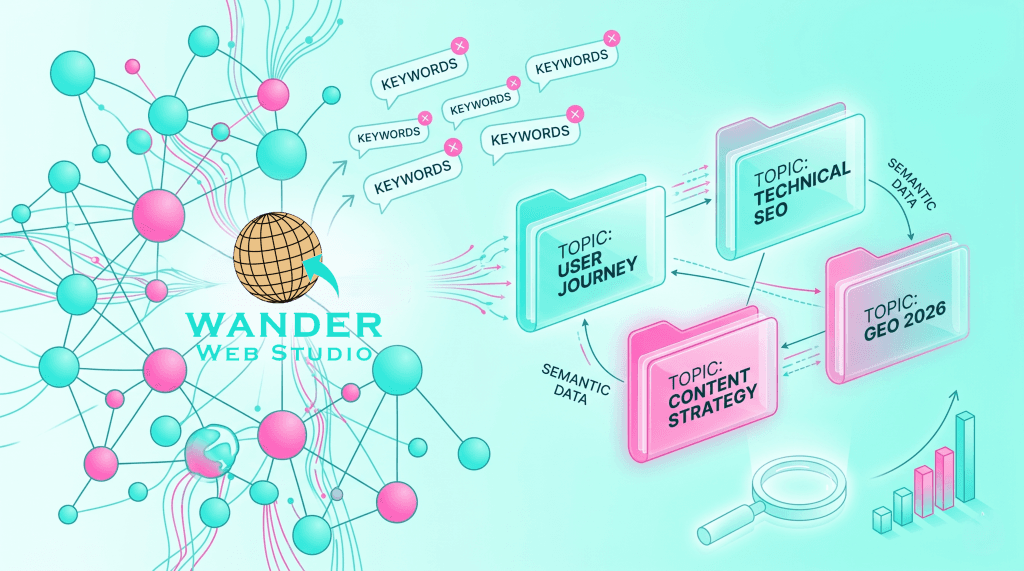
This is why “Content Clusters” have become the gold standard. When you organize your site around broad topics, you create a “web of relevance.” If you write about “Web Design,” search engines don’t just look for that phrase; they look for related concepts like “User Experience,” “Conversion Rate Optimization,” “Mobile Responsiveness,” and “Visual Hierarchy.” If your site covers all these bases, you’ve proven you understand the topic.
By building these semantic relationships, you are effectively “spoon-feeding” the search engines the context they need to rank you. This is why we prioritize Mastering the Pillar Page as the first step in any modern site architecture.
When you focus on topics over keywords, you are creating a comprehensive map of knowledge. By using Siloing to connect these pieces back to your Evergreen Content Strategy, you prove you aren’t just a one-hit-wonder. You are building a digital library that grows in value over time.
According to Moz, topical authority is now a primary ranking factor. It’s no longer about who has the most backlinks (though those still matter); it’s about who provides the most “Information Gain.” Information Gain is a concept used in 2026 search patents that measures whether a piece of content adds new value to the existing index or just repeats what is already there. Content clusters allow you to explore a topic so deeply that you naturally provide this unique value.
The Pillar Page: A broad, high-level overview of the main topic (e.g., “The Ultimate Guide to Brand Identity”).
The Cluster Content: Specific, detailed “spoke” articles that dive into sub-topics (e.g., “Psychology of Typography,” “Choosing a Brand Voice,” “Logo Versatility”).
The Internal Links: Every cluster post links back to the pillar, and the pillar links back to every cluster post. This creates a “loop” of authority.
Users search conversationally now. The era of robotic, three-word searches like “Web design Houston” has been largely replaced by long-form questions. Thanks to voice search and AI assistants, people are asking: “Who is the best web designer for creative entrepreneurs in Texas?” or “How do I know if my website needs a complete redesign?”
Content clusters allow you to answer the primary question and every conceivable follow-up question in one self-contained ecosystem. When you solve the user’s entire journey—from the moment they wonder “What is a brand?” to the moment they ask “Where do I hire a designer?”—you build an unbreakable bond of trust.
If your strategy is built solely on a list of keywords, your rankings are fragile. A competitor can simply write a slightly longer post with that same keyword and leapfrog over you. However, if your strategy is built on Topical Authority, you’ve built a “moat” around your business.
A competitor might steal one keyword, but they can’t easily replicate an entire Siloing structure of 20 interconnected, high-value articles that collectively own a topic. This is the difference between renting space on page one and owning the real estate.
By integrating your topical clusters with a clean 4-Step Audit, you ensure that your “Kingdom of Content” stays healthy, relevant, and profitable.
Wanderer’s Wisdom: I remember a client who was obsessed with ranking for the word “Consulting.” We could never move the needle because that word is too broad and too competitive. We stopped fighting for that one word and built a cluster around the topic of “Scalable Business Systems.” Within four months, they weren’t just ranking for “Consulting”—they were ranking for 50 different high-intent questions their clients were actually asking. They traded a lonely keyword for a flourishing kingdom.
In 2026, the goals of the user and the goals of the search engine have finally aligned. Both want deep, organized, and helpful information. By prioritizing topics over keywords, you are essentially future-proofing your website. You are creating a user experience that satisfies the “scanner” while providing the depth required by the “deep diver.”
At Wander Web Studio, we don’t just build websites that look pretty; we build content architectures that win. We help you move beyond “keyword chasing” and into a world of sustainable, authoritative growth.
Ready to own your niche and stop the keyword chase? Let’s build your content architecture today.
Turn your website into a high-performance business tool.
Through our parent company, Cocha Technology Inc., we are officially multi-certified as: WBE | MBE | SBE | HABE
4321 Kingwood Drive, Suite 222
Kingwood Texas 77339
Phone: 281-607-0616
Email: info@wanderwebstudio.com
Operating on Central Standard Time (CST) | Serving Clients Across All Time Zones
Copyright © Wander Web Studio. All Rights Reserved.