We’ve covered a lot of ground in this series. Templates that quietly blend you into the crowd. AI builders that trade real customization for speed. Proprietary platforms that trap you. What to truly look for before you hire anyone. The real math behind why “cheap” and “affordable” aren’t always the same word. If there’s one thread running under all six of those posts, I think it’s this: almost every problem we’ve described traces back to treating a website like a single transaction instead of an ongoing relationship.
So, let’s close the series here, with the idea I think matters most. A website growth partner — not a one-time builder, not a set-it-and-forget-it vendor, but someone who’s still there six months, a year, three years after launch — changes the entire trajectory of what your website can really become.
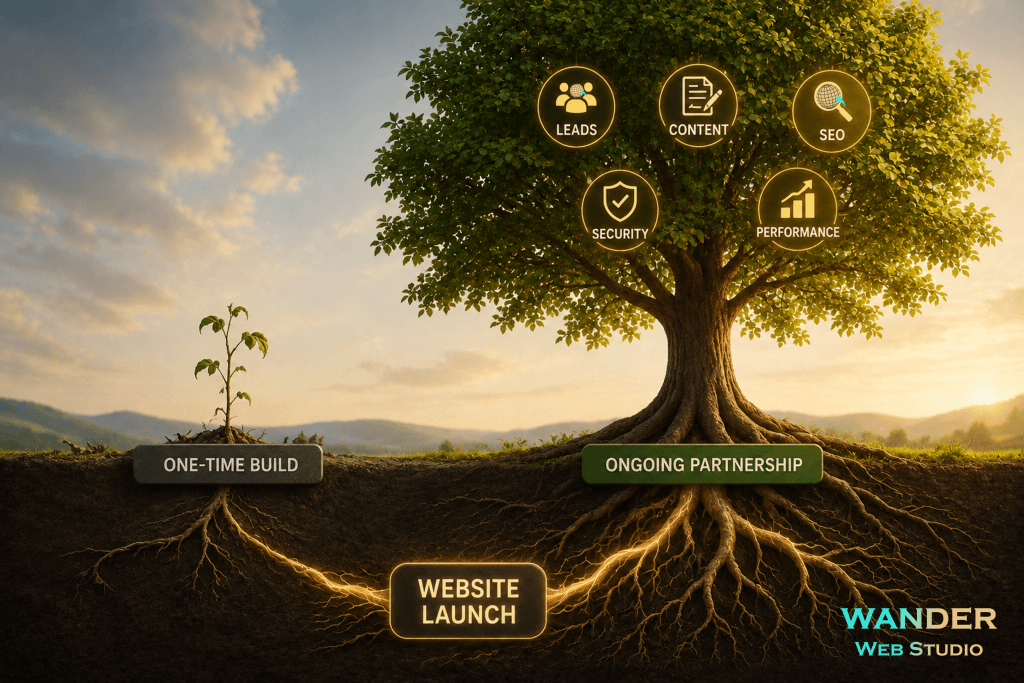
This is really the foundation of the whole idea. Your needs today are different from what they’ll be in two or three years, and a strong design partner offers services that scale alongside your business growth rather than freezing it at launch-day requirements. A website built once and left alone doesn’t fail because the build was bad. It fails because businesses aren’t static, and a static site can’t keep up with one that’s really growing.
There’s a real, measurable pattern here worth naming directly. A platform actively maintained over twelve months consistently outranks an identical platform that was launched and then left alone, because search engines continuously re-evaluate your technical foundation, not just your original launch quality. That’s not a marketing claim. That’s how search engines actually work — they reward sites that show ongoing signs of life and relevance, not sites frozen in whatever state they were in the day they went live.
I think this is the real question underneath everything in this series, honestly, and it’s worth asking directly. One framing puts it well: if all you need is a professional website, a one-time project may genuinely be the right solution — there’s no reason to pay for ongoing support if the site isn’t an important part of your marketing strategy. But if you want your website to generate leads, improve your visibility, and grow alongside your business, it’s worth thinking beyond launch day, because a website shouldn’t become outdated simply because time has passed. Neither answer is wrong. But they lead to genuinely different outcomes, and it’s worth being honest with yourself about which one you truly want.
Throughout this series, we’ve talked about a lot of things that go wrong quietly — outdated information nobody notices, security vulnerabilities sitting unpatched, speed that degrades gradually as content piles up. A one-time build has no mechanism for catching any of that. A genuine growth partnership does. With ongoing support, you get continuous growth built in — your website isn’t stuck in a time warp, and there’s someone actively keeping it fresh, relevant, and ready to perform, rather than discovering problems only after they’ve already cost you customers.
This might be the most important reframe in this entire series. A long-term partnership means your website isn’t just a cost sitting on the books — it’s an asset that grows in value the longer it’s actively maintained and improved. That’s a fundamentally different way of thinking about the money involved. A one-time build depreciates the moment it goes live — every month that passes, it drifts a little further from current best practices, current design standards, current business reality. An actively maintained site does the opposite. It compounds.
Here’s what I hope comes through, looking back across all seven of these posts. The DIY template trap, the AI builder limitations, the vendor lock-in, the vetting questions, the real cost math — none of these are in truth separate problems. They’re all symptoms of the same root cause: treating a website like a purchase you make once, rather than a relationship you invest in continuously.
That’s genuinely the mindset shift we’d love for you to walk away with. Not “spend more,” necessarily — plenty of businesses are well served by a solid, professionally built site and a lighter-touch ongoing relationship. But “understand what you’re actually choosing” — a project with an end date, or a partnership that keeps evolving as you do.
If you’ve read through this whole series and you’re recognizing your own website in some of the problems we’ve described — a template that never quite fit, a platform you can’t easily leave, a site that’s been quietly aging without anyone tending to it — that’s a completely normal place to land. It’s also a genuinely good moment to make a different choice than the one that got you here.
This is exactly what we mean when we talk about our own approach at Wander Web Studio. Our website building and design service starts the relationship. Our website maintenance and support service is what keeps it going — the ongoing attention that turns a launch into a genuine, compounding asset rather than a project that quietly starts aging the day it goes live. And if you’re not sure which stage you’re at right now, our about us page is a good place to start that conversation.
Even the way we think about content on this very blog reflects the same philosophy — deliberate, ongoing structure like internal link siloing isn’t something you set up once and forget either. It’s maintained, revisited, and built on, the same way we believe a website itself should be.
A website growth partner isn’t really about buying more services. It’s about recognizing that your website’s job never actually ends the day it launches — and neither should the attention it gets.
Turn your website into a high-performance business tool.
Through our parent company, Cocha Technology Inc., we are officially multi-certified as: WBE | MBE | SBE | HABE
4321 Kingwood Drive, Suite 222
Kingwood Texas 77339
Phone: 281-607-0616
Email: info@wanderwebstudio.com
Operating on Central Standard Time (CST) | Serving Clients Across All Time Zones
Copyright © Wander Web Studio. All Rights Reserved.