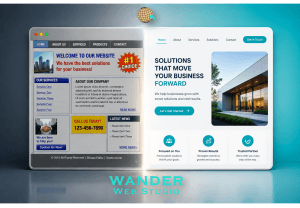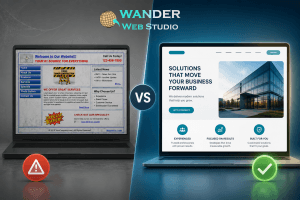
A client came to us a while back with a problem that, honestly, took me a minute to fully understand, because it seemed almost absurd once they explained it. They needed a small change made to their website. Nothing dramatic — updated info, a new section, the kind of thing that should take an afternoon. Except it didn’t. It took weeks. Multiple support tickets. A back-and-forth that dragged on far longer than the actual change warranted, because their website wasn’t really theirs to edit freely. It lived inside a proprietary, industry-specific platform, and any real change had to go through the vendor’s own process, on the vendor’s own timeline.
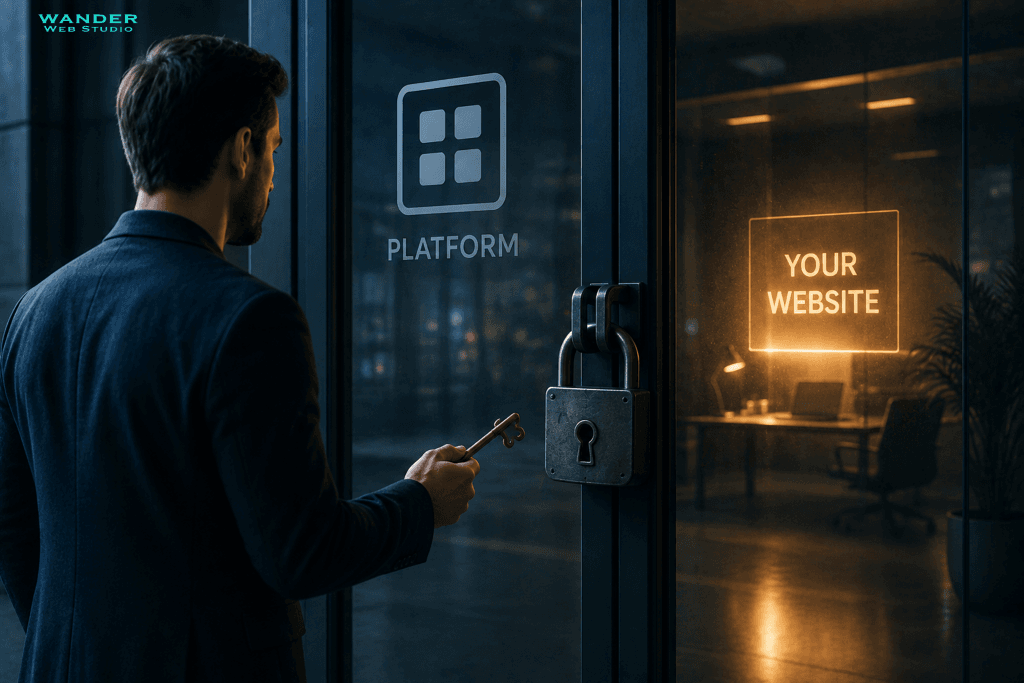
That’s website vendor lock-in, and it’s a genuinely different problem from the ones we’ve covered so far in this series. Templates limit your design. AI builders limit your customization. Vendor lock-in limits something more fundamental — your actual ability to control and update your own website, on your own schedule.
This is the clearest, most common sign. If updating your hours, adding a new service, or fixing a typo requires submitting a request and waiting for someone else to act on it, you’re not really operating your own website. You’re operating a request queue. Some industry-specific platforms are built this way by design — often for insurance agencies, financial services, and similarly regulated industries — where the vendor also handles compliance, marketing, and other back-office functions bundled together with the website itself. That bundling can genuinely simplify some things. It also means your website’s flexibility is only as good as that vendor’s support responsiveness.
A defining feature of vendor lock-in is that your data or content sits in a format only that specific platform can use. Practically, that means even if you wanted to leave, extracting your actual content — your pages, your structure, your years of accumulated SEO work — isn’t a simple export. It’s a rebuild, often from close to scratch, on whatever new platform you land on next.
Vendor lock-in isn’t usually an accident. It’s frequently a deliberate feature of how these platforms are built, because a business that can’t easily leave is a business that keeps paying. Industry research on this describes the core risk plainly: switching providers becomes difficult and expensive, limiting your options when circumstances change, whether that’s pricing, service quality, or your own business’s evolving needs. The difficulty isn’t a side effect. It’s often the point.
Closed platforms often require proprietary APIs or development frameworks that may not support a business’s evolving needs, which restricts scalability since businesses are confined to the vendor’s own capabilities and release schedule. If a competitor’s website gets a feature next year that yours can’t have because your vendor hasn’t built it yet, or has no plans to, that’s not a hypothetical risk. That’s the day-to-day reality of building on someone else’s proprietary system.
This is the deepest version of the problem, and it’s worth sitting with directly. One analysis of vendor lock-in described the situation bluntly: it’s not just about switching software at that point — your whole business is effectively being held hostage to the platform’s roadmap, pricing decisions, and priorities. Our client’s experience wasn’t unique in that sense — it’s a structural pattern that shows up across a lot of industry-specific platforms, not a flaw limited to any one company. Zywave, formerly Insurance Technologies Corporation (ITC), is one well-known example of this kind of vertical-specific platform in the insurance space; our client’s frustration was with the process and structure of working inside a proprietary system generally, not a claim about any single vendor being uniquely at fault. The pattern itself is the real issue.
To be fair, there are situations where this trade-off makes sense. Vendor lock-in tends to matter less for businesses with straightforward, predictable needs that closely align with what the platform already offers — in those cases, the platform’s limitations may never really surface in day-to-day operations. If a bundled, all-in-one industry platform genuinely covers everything you need and you don’t anticipate wanting flexibility beyond that, the convenience can outweigh the constraint. The risk shows up specifically when your needs grow, change, or diverge from what the platform was built to handle — which, for a lot of growing businesses, tends to happen eventually.
A few questions worth asking upfront, before signing on with any website vendor, proprietary or otherwise:
These questions matter just as much for platform selection as anything about design or SEO, and honestly, they get overlooked more often than either of those, because the lock-in usually isn’t visible until you’re already committed.
This connects to a theme running through this whole series — control over your own website isn’t just about avoiding frustration. It’s about being able to genuinely build the site strategically over time. A site you fully control can be organized deliberately, with practices like internal link siloing applied thoughtfully across your content — something that’s simply not possible when your structure is dictated by a vendor’s proprietary system.
If you’re currently on a platform that’s holding your business back this way, or you’re evaluating options and want a second opinion before committing, this is exactly the kind of conversation we have as part of our website redesign and development work — helping businesses move off restrictive platforms and onto something they genuinely own.
Website vendor lock-in isn’t always obvious going in. It often looks like convenience — one vendor, one bill, one place for everything — right up until the moment you need something the platform wasn’t built to give you and discover just how little control you in truth had the whole time.
We’ve covered what goes wrong with the shortcuts. Next, we’re flipping to something more useful: a practical vetting guide for what you should be looking for before hiring anyone to build or manage your website — developer, freelancer, or agency.
Turn your website into a high-performance business tool.
Through our parent company, Cocha Technology Inc., we are officially multi-certified as: WBE | MBE | SBE | HABE
4321 Kingwood Drive, Suite 222
Kingwood Texas 77339
Phone: 281-607-0616
Email: info@wanderwebstudio.com
Operating on Central Standard Time (CST) | Serving Clients Across All Time Zones
Copyright © Wander Web Studio. All Rights Reserved.