Quick gut-check. When’s the last time your website actually did something? Not “looked nice” — did something. Booked an appointment. Answered a question at 11pm so you didn’t have to. Captured someone’s email before they wandered off and forgot about you entirely. If you’re sitting there thinking, “huh, honestly… I’m not sure,” that’s worth paying attention to.
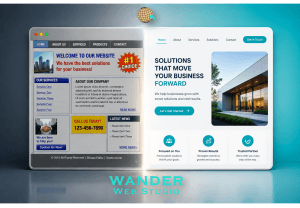
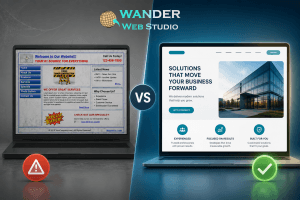
A lot of business owners treat their website like a digital business card. Something that exists, looks fine, and just… sits there. And look, I get where that comes from — it’s basically how websites used to work, twenty years ago. But that’s not what a website is supposed to be anymore. It’s supposed to be closer to an employee. One that works nights, doesn’t take sick days, and never gets tired of answering the same question for the hundredth time.
If the idea of “your website working for you” feels like a stretch right now, here’s what that’s really costing you.
This is the big one, honestly, and it’s shockingly common. A visitor lands on your site, likes what they see, and then… there’s nowhere for that interest to go except “call us” during business hours. If they’re browsing at 9pm, or on their lunch break they can’t make calls during, that interest just evaporates. No form. No booking widget. No way to leave their info for later. The lead just walks away, and you never even know they existed.
The Stat: 70% of small business websites lack a call-to-action (CTA) on their homepage.
Think about the questions you answer over and over, every single week, in calls and emails and consultations. If none of those questions live on your website, your site is quietly forcing every single visitor to go through the exact same conversation with you personally before they can even decide if they’re interested. That’s not a website working for you — that’s a website adding extra work to your day.
This is where “lack of integration” really shows up. Your website exists in one place, your calendar exists somewhere else, your customer records live in a spreadsheet or a separate app, and none of it talks to each other. A visitor books through a form, and then someone on your team has to manually copy that into your actual scheduling system. That’s not automation. That’s your website generating extra manual work instead of removing it.
The Stat: The “App Switch Tax”: Context switching burns up to 20% to 40% of productive time.
Here’s something worth sitting with: most people don’t buy, book, or commit on their very first visit to a site. They look around, they think about it, and — without some kind of follow-up mechanism — they usually just forget. An email capture, a simple automated follow-up sequence, even just a newsletter signup: these are what turn a one-time visitor into an actual future customer. Without them, your website is essentially forgetting every single person who almost said yes.
A lot of people, especially younger customers, genuinely prefer texting or a quick chat widget over picking up the phone. If your only contact option is a phone number and a generic contact form, you’re filtering out a real segment of potential customers who’d rather not call — not because they are not interested, but because the contact method itself feels like a barrier.
The Stat: Nearly 90% of consumers globally say they prefer texting or digital messaging with a business over calling.
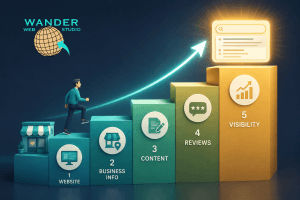
A working employee, you’d check in on. You’d know if they were performing well or barely showing up. Most websites, by contrast, get built once and then nobody looks at the numbers again — no idea how many visitors are becoming leads, which pages people leave from, whether the “contact us” button even gets clicked. Without that visibility, you can’t tell the difference between a website quietly working hard for you and one that’s just… there, technically online, doing basically nothing measurable.
I think it helps to picture the alternative concretely, rather than just in the abstract. A website that’s genuinely working for you looks something like this:
None of that is exotic. It’s mostly a matter of your site actually being connected — to your calendar, your CRM, your communication tools — instead of standing alone as a static digital pamphlet. This is part of why we think about site structure holistically, including things like internal link siloing – a website that’s organized and interconnected internally tends to be a website that’s also easier to wire up externally, to the tools that run your business.
It’s also worth saying plainly: this isn’t really a design problem. You can have a beautiful, modern site that still isn’t working for you in any of these ways — plenty of gorgeous websites out there are still functionally just brochures. Working for you is a different question entirely from looking good, and honestly, most businesses have solved for the second issue while completely skipping the first. That bridge between looking great and actually generating results is exactly what we build at Wander Web Studio—let’s talk about how to make your site work as hard as you do.
Part 2 of this post gets into exactly how to fix this — the specific tools and integrations that turn a passive website into something closer to an actual employee, one that’s generating and nurturing leads whether you’re at your desk or not.
For now, just ask yourself honestly: if your website disappeared tomorrow, would your business actually lose anything measurable? If the answer’s murky, there’s probably real opportunity sitting right there, mostly untouched. If you’re ready to turn your site from a passive showpiece into an active business asset, connect with our team at Wander Web Studio to get started.
Turn your website into a high-performance business tool.
Through our parent company, Cocha Technology Inc., we are officially multi-certified as: WBE | MBE | SBE | HABE
4321 Kingwood Drive, Suite 222
Kingwood Texas 77339
Phone: 281-607-0616
Email: info@wanderwebstudio.com
Operating on Central Standard Time (CST) | Serving Clients Across All Time Zones
Copyright © Wander Web Studio. All Rights Reserved.