In Part 1 of this series, we laid down the foundational concrete of your digital house: SEO (The Foundation). We fixed the technical piping, ironed out the site architecture, and mapped out a clean path for search engine crawlers.
But once your foundation is perfectly set, a new question arises: How far does your property line actually extend?
Many business leaders assume that if they rank well for a few core keywords on a traditional search page, their job is done. But in 2026, consumer behavior has fractured into new digital neighborhoods. People aren’t just typing questions into traditional search bars anymore. They are asking AI assistants to plan their projects, querying maps for immediate local solutions, and hunting for social proof across a web of interconnected directories.
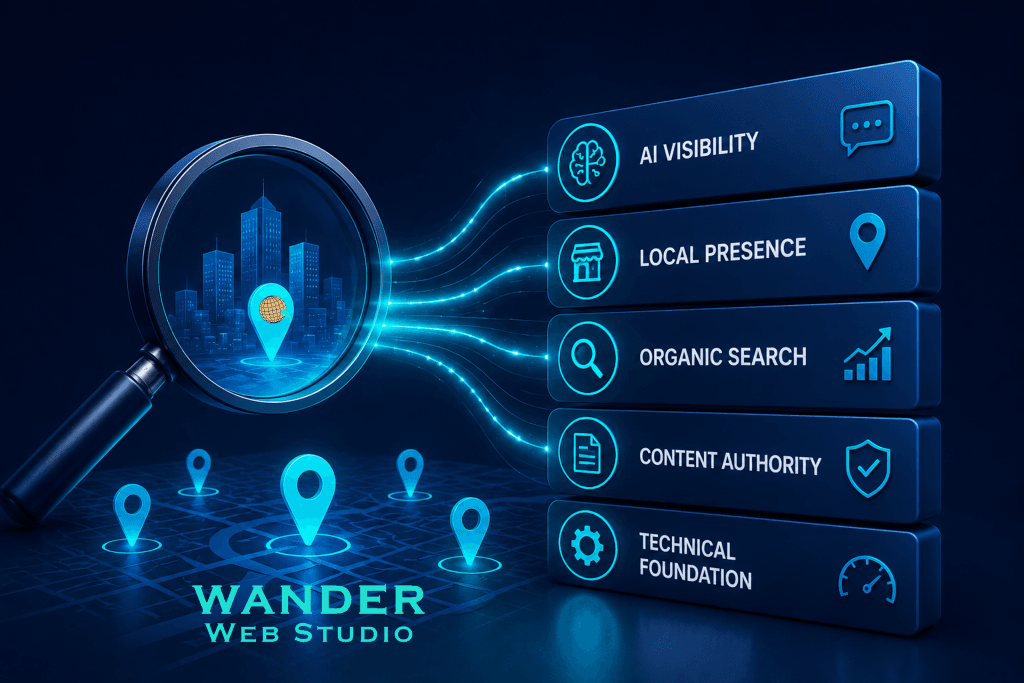
If SEO is the engine under the hood, Web Visibility is the total surface area your brand occupies across the digital universe. It’s about ensuring that no matter where or how a prospect searches for a solution in your industry, your name inevitably appears. Let’s dive into five critical pillars to broaden your digital footprint and dominate your market’s visual real estate this year.
To scale your reach, your marketing perspective must expand. True digital visibility means moving beyond a single website and focusing on your multi-channel brand footprint.
The way people discover information has drastically transformed over the last few years. According to market research data from the Sprout Social Index, over 56% of consumers now use alternative discovery channels—including social commerce, localized apps, and AI summaries—to evaluate brands before making a purchasing decision.
If your company only exists on its own domain, you are missing out on more than half of the modern buyer’s journey. By building out an omnichannel presence, you turn your brand into a ubiquitous industry fixture.
The absolute biggest shift in 2026 web dynamics is the mainstream rise of AI-driven search models. Platforms like Gemini, ChatGPT, and Perplexity are reshaping how users gather data. Instead of presenting a list of ten blue links, these engines compile a single, synthesized answer that recommends the top two or three companies.
To survive this shift, traditional SEO must evolve into Generative Engine Optimization (GEO).
AI models don’t just look for keyword repetitions; they scan the internet for context, conceptual relationships, and brand sentiment. To ensure your company is the one recommended by an AI assistant, your web content must utilize clear structural schemas and deep, conversational phrasing that maps out your exact entities. By creating definitive resource pages—similar to how we structure core topics on our comprehensive Wander Web Studio Services Page—you present data in the highly structured, easily readable formats that generative algorithms crave.
For service-based companies and physical storefronts, your proximity footprint is your lifeblood. When a customer searches for an immediate provider “near me,” they rarely scroll down to the standard organic listings. They click directly into the 3-Pack map results featured at the very top of the screen.
[Local "Near Me" Query] ---> 3-Pack Map Results (Gets 42% of All Clicks)

                                   |

                                   ---> Organic Listings (Gets Leftovers)
Optimizing for local search visibility requires intense care over your Google Business Profile, Apple Maps Connect, and local geographic citation consistency. Ensure your business name, address, and phone number (NAP data) are identical across every corner of the web.
Additionally, data from BrightLocal’s Consumer Review Survey confirms that 88% of consumers trust online reviews as much as personal recommendations. Proactively gathering high-quality, keyword-rich reviews from your clients signals to search engines that you are an active, highly relevant pillar of your local business community.
Sometimes, the fastest way to get noticed isn’t trying to fight massive corporations for a highly competitive keyword. Instead, you can attach yourself to an established giant that already owns the top spot. This strategy is known as Barnacle SEO.
Identify the primary directory platforms, chamber listings, and industry-specific aggregate sites that consistently rank on page one for your target terms. By claiming and optimizing your profile on these high-traffic portals, you win secondary visibility.
For example, our active networking footprints on community hubs and local business portals allow us to capture traffic from audiences who prefer browsing curated lists rather than digging through raw search results. To see how we weave our community focus into our operational identity, explore Wander Web Studio’s backstory
Web visibility isn’t limited to the written word. Images, videos, infographics, and podcasts are massive drivers of modern discovery traffic.
Google devotes an immense amount of mobile screen real estate to video snippets and image carousels. If your website only contains text, you are missing out on major vertical search funnels.
When you enrich your site with multi-format content, you keep visitors engaged for much longer. Behavioral tracking metrics from the Content Marketing Institute highlight that articles featuring mixed media assets earn 94% more total views and significantly lower bounce rates compared to text-only pages.
A sprawling digital footprint requires strong bridges to connect the pieces. Your visibility strategy should feature intentional, strategic outbound links to trusted security and technical infrastructure partners like Cocha Technology, while pulling inward toward your internal content assets.
By implementing an advanced internal Siloing approach built into your platform setup, you distribute link equity efficiently throughout your asset pool. This internal web helps search engines discover your deeper archival pieces, ensuring that your core pages continue to generate passive impressions and traffic continuously.
Wanderer’s Wisdom: The Billboard Network
Imagine owning a business and buying a single billboard on a quiet back road. It might look fantastic, but only a handful of people will ever drive past it. True web visibility is like buying an entire synchronized network of digital billboards across the busiest intersections in the city, the local transit stations, and the highway exits. You aren’t just hoping someone stumbles upon your main office; you are placing your signposts everywhere your customers naturally travel. Expand your digital map. Don’t let your business rely on a single road to be discovered.
As we close out Part 2 of our series, remember that being findable is a multi-dimensional challenge in 2026. True digital visibility takes the raw technical strength of your search foundations and stretches it out across AI models, local map packs, directory networks, and media channels. When you increase your total digital surface area, you turn your business into an unmissable industry destination.
Take a look at your complete brand footprint today. If someone searches for your primary service on an AI engine or a local map app right now, does your name dominate the conversation?
Ready to maximize your visual real estate and expand your digital footprint across the modern web? Check out our tailored service page to see how we launch high visibility platforms or connect with our team today!
Turn your website into a high-performance business tool.
Through our parent company, Cocha Technology Inc., we are officially multi-certified as: WBE | MBE | SBE | HABE
4321 Kingwood Drive, Suite 222
Kingwood Texas 77339
Phone: 281-607-0616
Email: info@wanderwebstudio.com
Operating on Central Standard Time (CST) | Serving Clients Across All Time Zones
Copyright © Wander Web Studio. All Rights Reserved.