Alright, so Part 1 was the diagnosis — the signs your site is basically just sitting there, technically online but not really doing anything for your business. Fair, but diagnosis without treatment is just anxiety, so let’s fix it. Turning your website as a sales tool — an actual working part of your business, not a static pamphlet — mostly comes down to a handful of integrations. Not a total rebuild. Integrations.
I think that distinction matters. A lot of people hear “we need to fix this” and picture a massive, expensive project. Sometimes it’s smaller than that. Let’s walk through the pieces that really move the needle.
If your current process for booking is “call us and we’ll find a time,” you’re adding friction that a lot of visitors just won’t push through, especially outside business hours. Tools like Calendly, Acuity, or booking plugins built directly into your site let someone see your actual availability and grab a slot right then, at 10pm on a Tuesday, without waiting for anyone to call them back.
This is probably the single highest-impact addition for making your website as a sales tool genuinely functional, especially for service-based businesses where booking a call or consultation is the real first step.
Not every visitor wants to fill out a form and wait. Some just want a quick answer, right now. A well-set-up chat widget — even a simple one that handles FAQs and routes anything complex to a human — captures interest in the moment instead of losing it to “I’ll come back later” (which, let’s be honest, rarely actually happens).
This connects directly to something we’ve written about before: making sure your site answers the questions people have, clearly, without forcing them to dig. We covered a version of this in our post on tiny details that make users fall in love with your site – a responsive chat option is exactly the kind of small detail with an outsized impact on how a visitor feels about you.
Here’s a scenario that plays out constantly: someone fills out a contact form, it lands in an inbox, and then it sits there for two days until someone happens to check that folder. By then, the moment’s gone — they’ve probably already found someone else. A proper CRM integration routes that lead automatically into your actual sales pipeline the second it comes in, with no manual re-entry and no risk of it getting buried.
This is genuinely one of the biggest gaps between a website that looks professional and a website as a sales tool that actually performs like one. The look has nothing to do with it. The plumbing behind the scenes does.
Most visitors don’t convert on their first visit. That’s just normal — nobody hands over their money the first time they encounter a business. What separates a passive website from an active sales tool is what happens after that first visit. An automated email sequence, triggered the moment someone submits a form or downloads something, keeps you in front of them without requiring anyone on your team to remember to follow up manually (because, honestly, manual follow-up is the first thing that slips when things get busy).
Even a simple three-email sequence — a thank-you, a bit of social proof, a gentle nudge to book — does more for your close rate than most business owners expect from something that basically runs itself once it’s set up.
The Stat: Email automations are 2% of email sends but drive 30% of email revenue,
You can’t improve what you’re not measuring, and a lot of websites are flying completely blind here. Basic analytics integration shows you where visitors come from, which pages they leave from, and whether your calls-to-action are getting clicked. Without this, every change you make to your site is a guess. With it, you’re making decisions based on what’s really happening, not what you assume is happening.
Search Engine Journal’s research on this points to a clear pattern: businesses using integrated marketing automation tools see meaningfully higher lead-to-customer conversion rates than those managing leads manually, largely because automated systems respond instantly instead of whenever someone happens to get around to it.
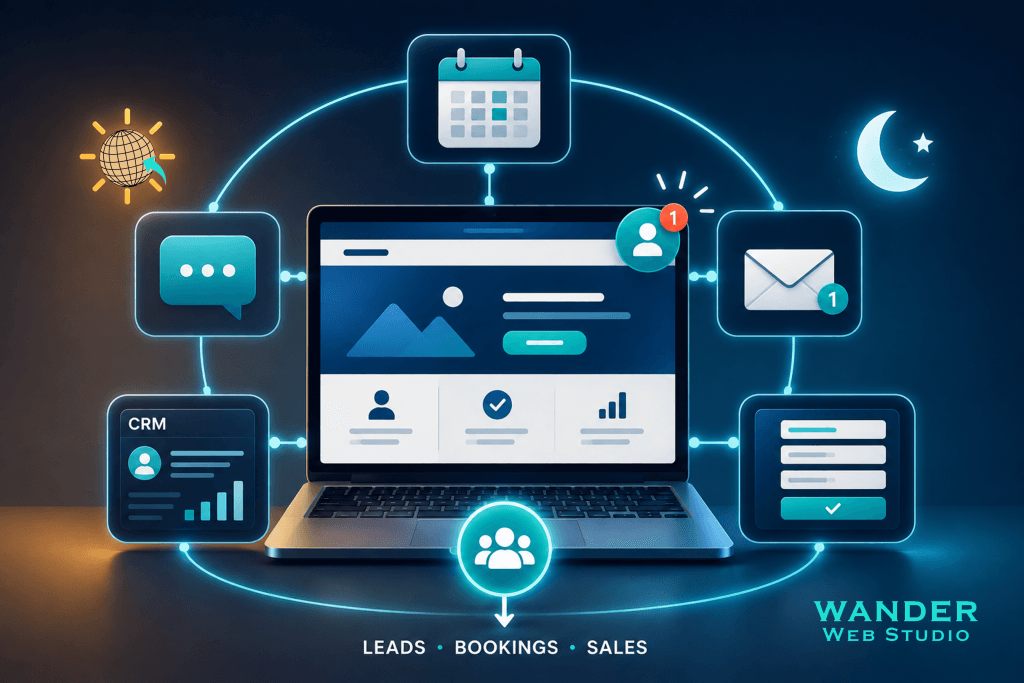
Picture the full loop for a second. Someone finds your site at 9pm through a search or an AI recommendation. A chat widget answers their first question. They book a consultation directly through your scheduling tool, no phone call required. That booking automatically creates a record in your CRM. If they don’t book — maybe they’re just browsing — they get added to a short-automated follow-up sequence instead of disappearing entirely. And you can see all of it happening in your analytics, in real numbers, instead of just hoping it’s working.
That’s the difference between a website sitting there and a website as a sales tool that’s genuinely part of your business. None of these five pieces are exotic technology. They’re mostly a matter of connecting tools that already exist, correctly, to a site that’s structured well enough to support them — which circles back to something foundational: a site with clear internal link siloing and clean structure is simply easier to wire these integrations into than a scattered, disorganized one.
If all five feel like too much at once, that’s fair — start with the two that address your biggest gap right now. If most of your lost leads happen after hours, prioritize booking and chat. If leads come in but go cold, prioritize CRM integration and follow-up sequences. You don’t need everything simultaneously; you need to close your biggest leak first.
This is genuinely one of the most overlooked areas of a website project, and it’s exactly the kind of work our extras and add-on features and integration support are built around — taking a website that already looks good and making sure it’s really pulling its weight behind the scenes.
A website that just sits there is a missed opportunity, quietly, every single day. A website as a sales tool is one of the few employees you can hire once and have working for you indefinitely, nights, weekends, holidays included, without ever asking for a raise.
Turn your website into a high-performance business tool.
Through our parent company, Cocha Technology Inc., we are officially multi-certified as: WBE | MBE | SBE | HABE
4321 Kingwood Drive, Suite 222
Kingwood Texas 77339
Phone: 281-607-0616
Email: info@wanderwebstudio.com
Operating on Central Standard Time (CST) | Serving Clients Across All Time Zones
©2026 Wander Web Studio. All Rights Reserved.